Epic bike tour in northern Portugal: part 1

My bike tour buddies: Graham, (center) and Chris (right) at the start of our ride near Viana do Castelo, on Thursday, Sept. 28.

As promised, I will recount here the amazing adventures of my bike tour in northern Portugal. I had planned to make the blog posts each evening during the tour, but I have to admit, I was too knackered. (That is a British slang word that means absolutely exhausted.)

So, here we go. On Wednesday, Sept. 27, I drove up to my friend Graham’s home near Montemor-o-Velho, where I we loaded both our bikes and gear into his car. We set off for Viana do Castelo about 2.5 hours north where we met with Chris, the third participant in this journey. We stayed at a wonderful Air BnB apartment in a complex called Chafe Amorosa (hmm sounds interesting). Then drove through Viana do Castelo the next morning and parked near the coast.

VdC is a charming city and port in northern Portugal. It is also on the way for pilgrims walking the coastal route to Santiago de Compostela, in Spain.

We set out about 10:30, Thursday, Sept. 28 on the 75 kilometer first leg of the three day trip. For the first few hours the Atlantic ocean was on our left, with waves rolling and crashing in over the rocks as we pedaled. We passed many pilgrims and spent some time talking to a pair of Australian bike tourists, Ken and Roslyn.

We spent the first couple of hours riding along wooden boardwalk and gravel trails with the crashing waves of the Atlantic Ocean on our left.
German pilgrims, Angelica and Veema who were walking the coastal route of the Portuguese Caminho Santago de Compostela.

We had a lot of confusion trying to figure out whether we should ride along the Caminho de Santiago, or the Eurovelo bike trail. A lot of the route took us on roads paved with bone-shaking cobblestones.

We had to stop by this group of goats while Graham tightened all the bolts on my bike rack that had been loosened by riding over cobblestones.

We reached the town of Caminha at about 12:30. The town is at the mouth of the large Rio Minho which forms the border between Portugal and Spain. We followed trails along the course of the river for another 20+ kilometers to Valença. This is a border town on the inland route of the Caminho de Santiago. A bridge from Valença takes visitors across the Minho into Spain. We continued following the river, passing mile after mile of plantations of kiwi fruit!

Our destination for the first night was Monçao, another small town on the Rio Minho. During the last 15 kilometers of the ride, our companion Chris started having a lot of knee pain. By the time we finally reached our hotel just before 6 p.m., he had decided he could not continue for another day. So, we had a great meal together that evening and enjoyed some of the very special local wine, which is a slightly sparkling red served very cold!

Our first day route, 75 kms from Viana do Castelo to Monçao.

Follow my blog to learn about the next two days of our ride!

Coming soon: bike tour in northern Portugal

Chris and Graham will be my cycling companions on the 3-day tour.

Tomorrow I am heading off for a very exciting adventure. I will be doing a 170-kilometer three-day cycling tour in northern Portugal. I will be riding with two guys with whom I have been doing rides over the past 18 months. Chris is an American , and Graham the tour organizer, is an Engishman .

We will rendezvous in Viana do Castelo where we will stay the first night. On Thursday we will start our ride. The first day will be a 75-kilometer stage taking us north to Caminha then east along the Rio Minho past Valenca to Moncao. We will be riding right along the border with the Galicia region of Spain.

I will be making blog posts along the way, so stay tuned!

Bike riding in the hills of central Portugal

Grape harvesting in Portugal, a labor of love

Volunteers from the local community turn out to help with the grape harvest.

September is a busy month in Portugal. It’s the time for the annual “vindima” (pronounced vin-deema), the grape harvest. Traveling around this small country you will see vineyards everywhere. Most of them are devoted to serious commercial wine production. Portugal is a major wine producing country. And of course the Douro valley near Porto produces the grapes that are used in making the world famous Port wines.

However, plenty of regular ordinary folks have their own little vineyards and when it comes to picking those grapes they depend on a lot of volunteers. I’ve helped out a couple of times since I moved to central Portugal and it’s an unforgettable experience.

I was told to be at a meeting spot at eight o’clock one September morning. Neighbors bundled me into their van and we drove to the first of the vineyards, located in a steep south-facing valley. I was handed a pair of clippers and a bucket and joined the other volunteers working our way through the rows of grape vines. When our buckets were full, we waved and a big burly guy came up and dumped it into a much bigger bucket. He hefted it onto his broad shoulders and carried it down to the truck.

No work without a feast

There were about thirty volunteers; men and women and children, even a couple of dogs. The dogs just supervised. We worked all morning, moving from one vineyard to another in different parts of he valley. We finished the last by early afternoon, then we all headed back to the home of the vineyard owner for our well-deserved feast. They had laid out long tables in their basement “adega”, or wine cellar. There was much food, much wine, music and lots of jolly conversation! Amazing what a little wine will do for your ability to speak a foreign language!

Do you give a fig?

Trays of figs drying in the sun.

Grapes are just one of the many fruits that are abundant at this time of year in Portugal. Fig trees are also everywhere. Most of them have the dark purple colored fruit, but there are also the pale green figs which are called “pingo de mel” or honey drop figs, in Portuguese. I have a huge fig tree on my land and have made lots of jam. I’ve also tried drying the figs. If you lay them out on a tray in the sun it can take around a week, but the result is delicious.

Walnuts are also in season. The other evening I saw my neighbors out with ladders and long poles knocking the walnuts off the tree. My dog loves to find them in the grass along the street. She bites off the outer green covering and crunches on the nut. I’m not sure they are good for her, but she is insistent.

And the fruit goes on: pomegranates, persimmons, pears, peaches. And in October, it will be olive season!

Follow my blog to learn more about daily life in Portugal. And check out my novel “The Power of Rain” on Amazon.

How a Portuguese dog found a home, love and a bread roll every morning

Hello, my name is Divina.

A couple of weeks ago I made a post about my dog Divina and I mentioned that she had been abandoned in my village in central Portugal. I thought I would let her “tell” her own story.

Divina: “I don’t remember much about where I was born or lived when I was a puppy. The only thing I do recall is that some ugly brute had his way with me when I was a teenager and I had a litter of puppies. I had just weaned them when they were taken away from me. I never saw them again because I was put in a van and taken to another village and dumped out on the street.”

“I spent several days wandering the village, trying to find food around the big green rubbish bin and sleeping on doorsteps. One day I followed another dog and his owners when they went to visit a new neighbor. As soon as the door of the house opened, I ran in. Unfortunately, the woman of the house didn’t let me stay. But the next day, I was out looking for food when the woman whose house I had visited, called me and invited me to come for some bread and milk. That was how I found my new home!”

Divina: “I soon made myself comfortable, sleeping on this very lovely sofa. Much better than a doorstep outside.”

Rosalie: “When I moved to Portugal in 2019, I had no plans to have a dog. It had been many years since my last dog passed away. In the meantime, I had become a cat convert. Sadly, I couldn’t bring my two cat ladies, Chatsie and Bodie because they were aged 12 and 13 and never traveled. A twice-yearly trip just three miles to the vet really upset them. Putting them through a 20-plus-hour trip on several airplanes would have been too traumatic. I found a very comfy home for them with a neighbor and they were just fine!”

The Universe provides its own surprises

Rosalie: “After traveling for two months I finally moved into my own house in July and immediately thought about getting a cat. However, the universe had other ideas for me. In the four years since the day I first welcomed Divina into my home, I have become very fond of her. She has me well-trained. I take her for several walks a day, give her treats, and –against my better judgment–let her sleep on the sofa.”

Morning delights

As I mentioned in a previous blog post, my village is lucky enough to have not one, but TWO bakery vans go through it each morning. You just put change in a bag and hang it on your gate or door and the bread lady (Padeira) will deliver the bread rolls of your choice!

In the last two months, Divina has fallen in love with one of the bread ladies, Paula, who now stops and gives her part of a roll each time we meet her on our morning walk. Divina recognizes Paula’s unmarked white van and pulls at the leash straining to go say hello and get her second breakfast. They have quite the relationship.

What can I say, it’s a dog’s life!

Follow my blog to learn more about daily life in Portugal.

Exploring historic sites in Portugal

Bridge over the swimming area beside Lousã castle in central Portugal.

Everywhere you turn in Portugal you are surrounded by ancient buildings that serve as reminders of this country’s rich history. That history includes centuries under Roman occupation, several hundred years under the Moors, and a period during which a Spanish king (Philip II) ruled over both countries on the Iberian peninsula.

Many of the castles were built by the Templars, an organization started by knights during the middle ages. Initially, they acted as protectors for pilgrims traveling to Jerusalem. Gradually they expanded their services to include a primitive form of banking, whereby pilgrims could get money along the way without the risk of having to carry large amounts of cash with them.

Castles such as the castle at Lousã in central Portugal were also defensive in nature. It stands atop a hill about two kilometers from the town of Lousã e Vilarinho. Built in the second half of the 11th century it dominates the landscape over the River Arouce. It is also called the Castle of Arouce.

The castle at Lousã, also known as the Castle of Arouce because of the nearby river. The sloping walls at the base were engineered to repel attacks. The castle is one of many defensive structures built the the Knights Templar organization during the Middle Ages.

More than just a castle

There are a lot of castles all over Portugal, but each one has something unique. At Lousã, there is a gorgeous river beach which is hugely popular during the summer. This river beach is different from many others which are usually found on a sandy bend in a river. The one at Lousã is more like a natural swimming pool surrounded by stone walls.

Swimmers cool off in the river beach beneath Lousã castle.

And if you plan on a day at this river beach, you can also enjoy a wonderful meal at the restaurant perched on a hill overlooking the water. O Burgo has an excellent menu with a wide variety of meat, fish, and chicken dishes, a wonderful house red wine, and superb service. You have to make a reservation, it’s a little pricy, but well worth it.

O Burgo restaurant at Lousã castle has been serving great meals since 1989.

Hiking opportunities

There are numerous trails leading from the area of the castle. If you reach the castle, you are at the launching point for a tour of some of the “Schist Villages.” In Portuguese they are called “Aldeias de Xisto”. This is a series of 27 remote villages where the houses are built of a distinctive type of stone known as “schist.” Visiting them is like stepping back in time.

Many of them were almost completely abandoned in the 20th century. But a project started in 2000 between the Portuguese government and the European Union has enabled them to be rebuilt and gradually repopulated. The area is very popular for hiking trails.

Follow my blog to learn more about daily life in Portugal.

Exploring the wonders of Portugal

Everywhere you go in Portugal there are reminders of its richly diverse history. It has ancient Roman ruins, medieval castles built to withstand assaults from Muslim or Spanish invaders, and modern marvels like the Arouca Bridge. Opened in 2021, and spanning 516-meters, or (1,692 ft), it is one of the longest pedestrian suspension bridges in the world.

I was lucky enough to visit the bridge this week with a group led by Jean-Remi Chapelon who runs the adventure company My-Green-Break. The sight of this awesome structure is enough to make anyone with a hint of vertigo pretty nervous!

However, the charming young guide who greeted our group assured us that it is VERY stable! Located in the mountainous Aveiro District of northern Portugal, it connects two sides of a steep valley over the Rio Paiva. At the midpoint, the drop is 175 meters, or about the same height as a fifty-story building. Our guide said tests showed it could support nearly two thousand people, but the number of those allowed to cross at any one time is limited to between 35 to 50 people. You have to buy tickets and you are assigned a crossing time.

Before we crossed, my group hiked along a path that led down to the river. Part of the path is on a wooden walkway called a “passadiço”. You find these all over Portugal. They are built beside rivers or even over the dunes beside the ocean. At the midpoint of our 7-kilometer hike, we stopped to eat a picnic beside a river beach where many people were swimming. River beaches, or “praias fluviais” are popular in Portugal.

Our guide. The bridge was built at a cost of 2.3 million euro. The money came from the local government and the European Union.

As we crossed we could feel slight movement beneath us, and it became very windy. But I never felt unsafe. The view over the valley and down to the river below was spectacular! Well worth the trip.

Follow my blog to learn more about daily life in Portugal. And check out my website, RosalieRayburn.com

A Portuguese dog’s tale

Divina, the little dog who was abandoned in my village and adopted me as her person. She has been a great companion.

Anybody who has been following my blog since I moved to Portugal in 2019 will have read about Divina. She is the little Podengo-mix dog who was abandoned in my village around the time I moved into my house. She showed up at my door and I offered her some food and she decided to adopt me.

It had been many years since I had a dog. I really didn’t have plans to welcome another one into my life. I’d had a couple of cats for several years and sadly could not bring them with me because I was “of no fixed abode” when I arrived in Portugal. Instead, I found them a cushy home with a lovely neighbor who wanted a couple of middle-aged felines.

But this little Podengo-mix made herself right at home in my house, so I didn’t have much choice. There are too many abandoned dogs in Portugal!

In the four years since she has become my constant companion. She gets me up in the morning with the sound of her ears flapping as she wakes up. And she gets me out of the house early because she loves her morning walk!

About that walk

I am lucky enough to live in a village that is on the delivery route of two different bakeries! That’s right. A van drives by my house six mornings a week and all I have to do is put a bag on my gate with the right change and the delightful “bread lady” puts the fresh bread rolls into the bag. Yum!

The bread van that comes by my gate every morning delivers rolls. It comes from a bakery called “Pecado Divino”. Loosely translated it would mean “sinfully delicious”. I liked the idea so much that I used it to name my dog. Hence “Divina.”

The bakery that delivers the rolls I like is called “Pecado Divino” which translates as “Divine Sin.” That may sound a little odd in English, but if you think of the way we often describe eating chocolates or delicious cakes we say, “sinfully delicious.” I loved the idea so much that I adapted it to name my dog, calling her Divina. (She is feminine after all! You have to follow grammatical rules.)

It so happens that there is another bread van. I don’t know the name of that bakery because the van is plain white. Now a lot of plain white vans go through my village every day. They pass by while I am walking Divina down the main street. But she has come to recognize THE white van from the bakery. How? Because Divina and I happened to walk by one fine morning when that bread lady was stopped outside a house picking rolls from the back of the van and putting them into the bag hanging on the gate. The very nice lady saw Divina’s soft brown eyes and wagging tail and pulled off a chunk of bread and gave it to her.

So now, every time that van comes through the village when we are coming back for our walk Divina immediately recognizes it and strains on the leash to go say hello. Of course, the very nice bread lady recognizes her too.

Ah, the life of my little Portuguese dog!

Follow my blog to hear more about my adventures living in a Portuguese village. And check out my novel “The Power of Rain” on Amazon and my website: RosalieRayburn.com

Divina, my companion.

Healthcare options in Portugal

A sign pointing to a health center (Centro de Sade) in a village in central Portugal.

Portugal has a universal healthcare system which is available to foreigners who are legal residents. The system has is a network of clinics and pharmacies in towns and villages all over the country. Usually, these health centers, “Centro de Saude” are open just a few hours a week. Ideally, there is a doctor who is available during these times, but some centers only have a nurse. The Covid situation put the Portuguese health system under great strain.

Fortunately, I enjoy good health and have had little reason to use my local health clinic. The only times I have been are few and far between. When I first arrived one of my new neighbor’s little dogs bit me and I had to get a tetanus injection. This was actually a blessing in disguise, because it obliged me to go to the main health center for my “Concelho” or municipal area, to register in the system. I had to provide identification and my residency permit and was eventually given a “numero de utente” or user’s number. This is the number you must always show when seeking to use any of the services in the Portuguese healthcare system.

The other time was when I was having some digestive issues. I went to the clinic in my local village and the nurse told me to wait. I was able to see a doctor who spoke English. He ordered a battery of tests which included bloodwork, electrocardiogram, abdominal sonogram and an endoscopy. Because I am over 65, I didn’t have to pay for the doctor visit. (People under that age usually have to pay a few euros.) I was only charged for one of the tests, and staff apologetically explained that it would cost me 15 euros!

Impact of Covid

Unfortunately, the Covid pandemic made it harder to access healthcare services during the past two years. Several hospitals had to temporarily close departments because of a lack of staff. The clinic in my local village did not have a doctor available for about a year. In order to see a doctor, you either had to go to the main municipal clinic on a Saturday morning, or go to the local hospital. Either option was about (16 kms) or 10 miles away.

Despite these drawbacks, Portugal had an efficient system for alerting people when they were eligible for a Covid vaccination or a flu shot. I received a text message on my mobile phone and sent a return text with my Utente number to confirm. I also received a letter in the mail giving me an appointment to get a mammogram at the mobile unit when it was visiting my area. No cost for the vaccinations or the mammogram!

Healthcare a draw for many

The soaring cost of medical care in the United States has made the prospect of access to quality care, at a fraction of the price, a powerful draw for many Americans who have moved or are planning to relocate to Portugal.

Legal residents of Portugal can use the tax-funded national health service, SNS (Serviçio Nacional de Saúde), a system of local clinics and regional hospitals, either free or at minimal cost.

“The public health system here is basically free. You don’t pay for appointments, surgeries, all that,” said Fernando Mendes, an insurance agent based in central Portugal.

In addition, there is a growing network of private facilities and providers, such as Hospital de Luz, CUF and HPA, available to those who pay for medical insurance.

The public and privately funded health systems have earned high recognition. The World Health Organization ranked the delivery of health care in Portugal 12th in its 2019 World Health Report.

Numerous private health insurance options are available in Portugal through companies like Fidelidade, Allianz, Advancecare, Cigna, and Medis. Coverage for pre-existing conditions is not typically available through these plans. The Association of Foreign Property Owners in Portugal (AFPOP) also offers its members special insurance rates through Medal Seguros. Their plans will cover pre-existing conditions under certain conditions. This is not the case for most private insurance plans offered in Portugal.

Navigating Portuguese Hospitals is a Facebook group that helps people navigate the Portuguese system.

A sign outside a hospital showing where to go for urgent care and admissions, visitors, and administrative services.

Tomar festival brings young and old together in one joyful community

The Cortejo dos Rapazes, or children’s parade is the first of many parades in the Festa dos Tabuleiros, an event unique to the town of Tomar in central Portugal. It’s origins date back to a medieval festival to honor the Holy Spirit.

The Festa dos Tabuleiros, or festival of the trays, is an event unique to the town of Tomar in central Portugal. It happens once every four years and draws upwards of half a million visitors to the town of around 23,000 residents. The most stunning feature of the event are the parades of girls or women carrying tall headdresses made of stacked bread rolls and flowers, topped with crowns. They wear traditional costumes of white blouses and long white layered skirts with a colored sash and beige suede shoes.

Seeing as the headdresses are more than a meter tall (think 4 feet) and weigh several kilos (20 lbs or more), each girl or woman has a male companion to help her as she processes. The boys and men wear black trousers, black shoes, white shirts and a tie the same color as their companion’s sash.

Its a huge honor to participate. Kids as young as three or four march along in the children’s procession. The tiniest children carry baskets of flowers rather than trying to cope with the heavy bread-and-flowers headdress. They march through the streets of the town and end up in the Praça da Republica in front of the Igreja de São João Baptista (church of St. John the Baptist), where a priest blesses them. This festival originated in the Middle Ages as a way to honor the Holy Spirit, (Espirito Santo)

Lots of Music

Of course, no Portuguese event is ever complete without a marching band. Now I know how the US got its famous marching songs like “The Stars and Stripes Forever”. Composer John Philip Sousa had Portuguese blood!

There is plenty of music at night too. During the ten-day festival, there is a stage set up in one of the town parks beside the river Nabão where you can hear traditional Fado music or jazz. The main music stage is in the huge Varsea, or plaza in front of the train station. The bands strike up at ten p.m. and go on until the wee hours.

Colorful Streets

In addition to the parades, residents of the town form groups to decorate their streets. It brings together old-timers and foreigners of all nationalities who have settled in this charming town. I’ve met British, American and Portuguese women (it seems that most of the decorators are women) who have participated in the groups. They’ve been working together for almost a year to create a themed design and hand make the millions of paper flowers that go into the decor. It’s highly competitive. On a particular night during the festival the streets are closed off so the decorations can be set up. Then, at the appointed hour, the church bells ring, and the judges begin touring the streets one by one to pick the winning design. The themes are very innovative. I saw a whole street decked out in a maritime theme with a giant octopus, fish, waves, and plenty of fish!

Follow my blog to learn more about daily life in Portugal. And check out my book “The Power of Rain” on Amazon.

Useful things to know about life in Portugal

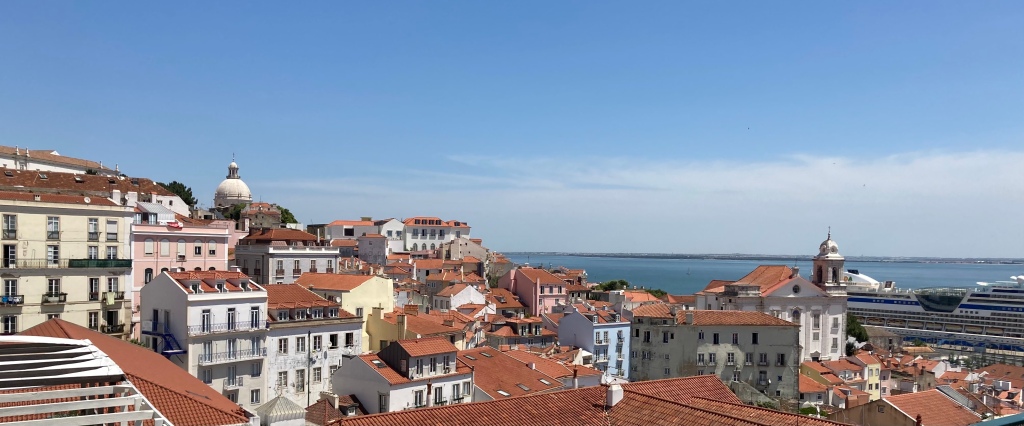
Rayburn/Lisbon skyline
The red tiled roofs of Lisbon’s Alfama district look out over the Tejo river.

I have been living in Portugal for almost six and a half years now. Almost every day I learn something new about this country and its culture. It may be a new word or expression in Portuguese. Or it may be noticing a new flower, fruit, or vegetable. Or just figuring out another aspect of the inevitable bureaucracy that goes with moving to a new country.

When I first moved to a house in a village in central Portugal, I was terrified of driving on the narrow winding roads. I used to grip the steering wheel and hold my breath when a van approached me at speed, wondering if there really was enough room for us to pass each other. Now, I don’t give it a second thought.

I’ve also relaxed when it comes to being overtaken. Portuguese drivers fall into two categories, as far as I have observed. They either drive irritatingly slowly or they do rally driver impersonations. The latter type suddenly appears behind you as you are motoring along a country road minding your business. Then, as you approach a blind corner or a hill, that’s the moment they choose to roar past you. It can be breathtaking!

Banking

Living in the country, I find I use cash a lot more than I used to in the U.S. A lot of the small businesses and restaurants do not accept payment by debit card, multibanco, as they say in Portugal. I even have to pay cash at the garage where I get my car worked on.

Luckily, the caixa automatica (ATM, cash machine or cashpoint in the UK) in Portugal is supremely useful. If you are coming from abroad, you can use your debit card to withdraw euros. If you have a Portuguese bank account you can go to any ATM and get cash without having to pay a fee. The ATM machines here also let you do a number of other operations like paying bills, road tolls, taxes, and fines.

The banking app I have on my phone has a capability called MB Way (multibanco way) which enables me to pay individuals if I have them listed as one of my contacts. I can also pay bills from my phone by using the IBAN number of the payee.

Various useful odds and ends

Here are a few other tidbits I’ve learned or noticed in Portugal.

* Bathrooms: lights may be on timers, so you may be plunged into darkness while you are doing your business  – wave your arms around, which usually activates the lights.

* Toilet paper: a lot of Portuguese homes or businesses are on septic systems which get clogged with toilet paper. They ask you to put the TP in a bin provided. For women it can be hard to re-learn the habits of a lifetime.

* Tickets for many trains and bus trips give assigned seats. If you are 65 years old and older you travel half-price on the trains.

* Portuguese people are not huggers. Expect an air kiss on each cheek even from business people you’ve never met before.

* In big cities the bread, cheese, and olives they put on the table before they bring you your meal are usually not free. The charge can be from one to five Euros. Beware. You can often get a fixed-price meal by looking for the “Prato do dia” or dish of the day. In the small local restaurants in my area the prato-do-dia price is usually as little as 10-12 euros, with wine, dessert and coffee included.

Follow my blog to learn more about daily life in Portugal, and my website, RosalieRayburn.com

Scene along the River Douro in Porto, Portugal’s second largest city.