The prospect of a steaming bowl of home-made soup is irresistible on a damp Sunday in January. Soup festivals are an annual tradition in towns and villages all over Portugal. In the village where I lived for five years, people flocked to the local parish hall to sample the mouth-watering soups and enjoy good cheer.
The events are all volunteer-run by community members. Volunteers set up the tables, issue the tickets, and, of course, make the soups. Festival goers pay just 10 euros for the privilege of trying as many soups as they can eat. The entry fee includes a traditional-style soup bowl created for the event. Many people collect them over the years.
The 10 euro festival ticket includes a soup bowl unique to the event.
The 2026 Festival das Sopas in my village sported nearly twenty different kinds of soup. Most of the soup chefs were Portuguese, but foreigners living in the community participated too. They included a woman from Holland, an American from Louisiana who made gumbo, a woman from South Africa, and a couple from the UK who made French Onion soup.
People lined up well before the doors opened. By the time the event was in full swing, I estimated a crowd of more than 200 people was busily sampling bowl after bowl. A friend of mine said she ate eight bowls! I was stuffed after five.
Some of the most popular Portuguese soups are the Sopa da Pedra and Caldo Verde. The Sopa da Pedra, or stone soup, is usually made with kidney beans, the spicy Portuguese chouriço sausage, pork ribs, bacon, potatoes, onion, and garlic. Caldo Verde is a kale soup. Check out these links to find the recipes.
Soup with a legend
Sopa da Pedra has a story behind it, a common theme found in several cultures. Supposedly, a group of hungry travelers stopped near a village. They had no food, but they had a large pot that they filled with water from a nearby stream. They put a stone in the pot and set it over a fire to boil. Curious passersby asked what they were doing. The travelers answered that they were making stone soup, but they needed a few more ingredients. Some people donated carrots, others peas, cabbage, and so on. Pretty soon, they had a rich, hearty soup that everyone enjoyed.
Of course, the work of the volunteer chefs is recognized. Not just by the happy smiles of those who line up to taste their soups, they also get a plaque to thank them for their hard work.
Volunteer chefs display the recognition awards for the 2026 Festival das Sopas.
The Tucson Festival of Books in mid-March is one of the biggest book events of its kind in the US.
In just a few weeks I will be headed to the Tucson Festival of Books, one of the biggest book fairs in the US. Held each year on the campus of the University of Arizona, the festival attracts 300 to 400 authors and tens of thousands of visitors. This year, it will be March 14 to 15.
At the event, I will showcase my latest New Mexico-based mystery novel, Windswept. This is the third book in my Digger Doyle mystery series, featuring my intrepid reporter/detective, Elizabeth “Digger” Doyle.
Windswept: One Dead Politician. One Missing Girl
Windswept is a murder mystery set in New Mexico.
In Windswept, reporter-turned-detective Digger Doyle confronts political power, buried crimes, and a cold case that refuses to stay buried.
Working for a scrappy online newspaper in Albuquerque, Digger travels to a press conference at a remote wind farm in eastern New Mexico. The featured speaker is state representative Carmen Lawlor, a controversial figure whose efforts to block new oil and gas drilling have earned her dangerous enemies. The press conference never happens. Lawlor is found dead at the base of a wind turbine. Was it an accident—or murder?
A veteran radio reporter hints that Lawlor’s death may be tied to a decades-old mystery: the disappearance of eighteen-year-old Julie Mondragon in the desolate Malpais volcanic wilderness. Before she can explain more, the reporter herself is dead. The message is clear—someone wants the past to stay hidden.
Featured on BookSirens
I am also excited to announce that BookSirens is featuring “The Sunshine Solution“, the second book in the Digger Doyle series, in its murder mystery selections for January. BookSirens is a website where readers can discover new books and write reviews. Here is a taster of the plot.
A fearless reporter, a passionate activist, and a battle against corruption in the Southwest.
A routine press conference shouldn’t feel dangerous—but investigative reporter Digger Doyle knows when something doesn’t add up.
Now working inside New Mexico state government, Digger uncovers a solar project hiding more than green promises. Following a trail of money and deception from Chaco Canyon to the corridors of Santa Fe power, she stumbles onto a conspiracy engineered to destroy a man’s political career.
As the lies tighten, Digger must decide how far she’s willing to go for the truth—and who will pay the price when it comes out.
BookSirens is featuring The Sunshine Solution in its Mystery books for January.
I wanted to write books ever since I was about eight years old. As soon as I could read, I devoured the Nancy Drew and Hardy Boys mysteries. I read the early sci-fi books about Tom Swift and his various escapades. When I was in third grade, and my brother was in first, I used to tell him stories as we walked to school. The stories were about a battle between two tribes of fictional space creatures, the Findons and the Cordons. I progressed to becoming a journalist for twenty-five years. Now retired, I have written the three Digger Doyle mystery novels inspired by my experiences as a reporter for the Albuquerque Journal in New Mexico.
Every author aspires to be a best seller. Well, maybe not, but every writer certainly hopes many, many people will enjoy reading their books. I belong to a writing group and at a recent meeting we asked each other why we write. Every one of us said we write because it is a compulsion, because it is as much a part of us as breathing.
So, I am hoping you will discover Digger’s world, where she fights to expose corrupt politicians, shady developers, and falls in love! Take a look at my website, RosalieRayburn.com
My three Digger Doyle Mystery novels are available on Amazon.
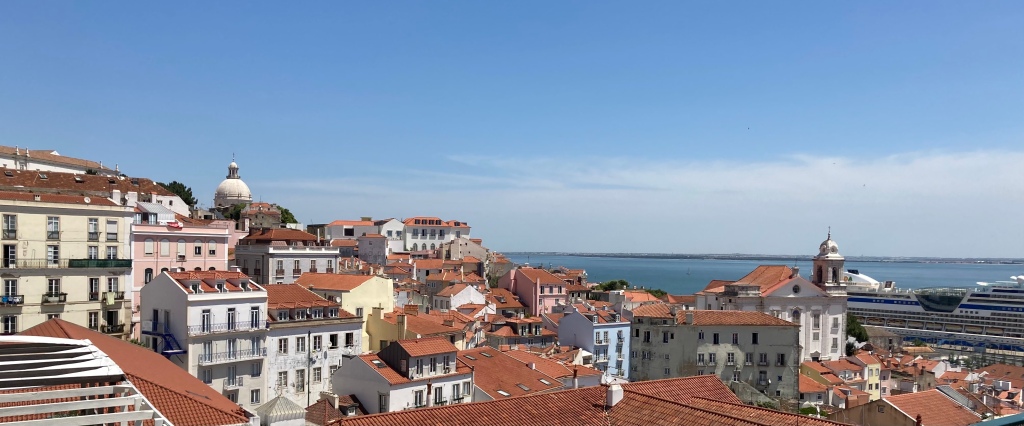
The red tiled roofs of Lisbon’s Alfama district look out over the Tejo river.
Portugal has become a much sought-after destination for many US retirees. I have to admit that I fell in love with the country when I visited it for the first time in June 2011. I moved here in 2019 and I am still in love!
For anyone considering the move, I always advise making a reconnaissance trip to the country. You can do all the research you like online, but nothing beats an in-person experience. One of the most wonderful things about Portugal is the interactions with individual Portuguese people. You will find so much kindness and charm.
That said, here are some of the things that people ask about when they post questions on the numerous Facebook groups that cater to expat interests.
It may come as news to some, but Portugal is not a mediterranean country. The western and southern coastlines are on the Atlantic Ocean. The Mediterranean sea ends at the straits of Gibraltar.
Still, Portugal’s climate is mild in winter. In the center and north of Portugal it can rain a lot during the autumn and winter. The weather is warm to hot in summer, the further south you go, the hotter and drier it is. For details, check out: https://www.expatica.com/pt/moving/about/portugal-climate-100067/
Cuisine
Portuguese food tends to be unsophisticated compared to, say French cuisine. But the ingredients are usually fresh and the cooking is honest. They do grilled meats, chicken and fish very well. Sardines and cod fish are hugely popular. The country produces excellent olive oil and lots of good quality inexpensive wine. And Port of course! For details on Portuguese food, check out: https://www.portugal.com/food-drink/10-best-portuguese-foods-and-dishes/
So start researching your journey! Follow my blog to learn more about daily life in Portugal.
An array of snacks laid out before a Christmas Eve dinner in Portugal.
Festive lights and throngs of people reflect the lively Christmas spirit in the Baixa area of Lisbon.
Christmas spirit is everywhere in Portugal in December. Markets in cities and towns sell handmade specialties and decorations. Churches and public places stage nativity scenes called “presépio” in Portuguese, and the streets of my small town of Tomar, ring with Christmas music.
December began with the usual wet weather. Rain in Portugal often falls in torrents and many people complain of dampness in their homes. But the Christmas spirit survives. The town of Tomar, near where I live in central Portugal, always sets up a mini-winter wonderland in the Praça da Republic, its main square. A couple of years ago tiny train chugged around a snowy landscape, and a festive carousel twirled round while several market stalls sold artisanal items, sweets and seasonal drinks. This year, the decorations are more modest, just a few bouncy castles and the artisanal stalls.
Of football and families
My Portuguese teacher recently told me Portugal is all about the three “Fs”, which stand for “Football, Fado and Fatima.” The first one needs no explanation to anyone who was alive during the last month when the World Cup dominated the sport world. Football (soccer in the US) is practically a national religion in Portugal. When I watch the evening news on SIC Noticias, there is about five minutes of spot news coverage before it switches to interviews and discussions about leading Portuguese teams such as Benfica. And of course, Cristiano Ronaldo, is pretty much a national hero.
Fado is the traditional Portuguese singing style, which has a slightly mournful sound meant to convey a sense of longing. Fatima is a pilgrimage site in central Portugal where the Virgin Mary is said to have appeared to three shepherd children in 1917.
There should also be a fourth “F” for Family. The family is extremely important to Portuguese people especially at Christmastime. On Christmas Eve, families get together to celebrate with a meal called “consoada”. The tradition is that they abstain from meat, so the main dish is salted cod “bacalhau.”One favorite recipe for the cod is “bacalhau com broa” in which a bread made from corn meal is used along with sliced onions and potatoes. This is often served with boiled potatoes and cabbage. In the north of the country, close to the border with the Spanish province of Galicia, octopus is a traditional dish.
On December 25, Portuguese families in typically resourceful fashion, use the leftovers from the consoada meal to make a dish known as “roupa velha” or “old clothes. I remember a similar sounding dish called “ropa vieja” on the menu in a Cuban restaurant in Miami. When I went to order it, I made a critical mistake, calling it “ropa sucia” which means “dirty clothes. Luckily the waiter understood what I wanted.
Sweets and other traditions
Portugal has wonderful bakeries where you can always find a tempting display of sweet pastries. Stores everywhere at Christmastime sell the traditional “Bolo Rei” (king cake) which is a round, rather heavy, cake decorated with crystallized fruits in red and green.
Streets and marketplaces in towns all over the country are festooned with lights and decorations. Seasonal markets selling artisanal crafts and liqueurs are typical as well. And what would Christmas be without a nativity scene. In Portugal a nativity scene is called a “presépio”. One of the best-known presépio displays is in the town of Penela, central Portugal. Set up around the town’s hilltop castle, it features around 200 animated displays as well as an array of street entertainment and cultural activities.
Merry Christmas and Happy New Year, or as they say in Portugal, Feliz Natal e um prosper Ano Novo.
And of course, don’t forget to follow my blog and read my Digger Doyle Mysteries.
A giant conical yuletide tree graces the Praça do Comercio in Lisbon at Christmas time.
The Left Bank, a former bank property, is in the center of Kilkenny.A warm fireplace and original art in the dining room at the Left Bank gastropub.Jameson whiskey bottles form a Christmas tree
November is not the best time to visit Ireland; after all, the country is known as the Emerald Isle because of its abundant rainfall. However, a late autumn visit provides the perfect excuse to sample the cuisine. Irish cuisine? You say, mockingly? Yes, in recent decades, the diversity of food available at hotels, cafes and pubs throughout Ireland has undergone a miraculous transformation.
The boring old boiled bacon, boiled potatoes, and boiled cabbage of old have been replaced by a dizzying array of Asian-inspired curries, salads bursting with formerly rare items like pomegranate seeds and feta cheese, and an assortment of vegetarian options, with nary a hint of boiled cabbage!
I know whereof I speak. I lived in Ireland in the 1970s and 80s, and I recently made a visit to the Auld Sod. On our first full day, we explored the city of Kilkenny and had lunch at the Left Bank. This is a truly impressive place. The former bank building has been transformed into a complex with a piano bar, patio bar, and atmospheric dining room. Very cosy on a rainy day!
Of Crystal, Saints and Kings
Our trip took us south past the thriving city of Waterford, founded in 914 by the Vikings. Those ancient Scandinavians were also responsible for settlements in Wexford and Dublin. More recently, Waterford was known for exquisite hand-cut crystal. The factory is still in the city center, although much of its production has been outsourced to Slovenia and the Czech Republic.
After a couple of nights outside Cork city, and a quick visit to the small town of Kinsale, where we had another excellent meal. The new version of the traditional fish and chips is not your newspaper-wrapped meal eaten with your fingers. No, this was a huge piece of beautifully battered cod served with a slice of lemon and crisp, crunchy chips.
Heading back northeast, we stopped in County Tipperary to see the famous landmark known as The Rock of Cashel. Set atop a hill that dominates the countryside, this cluster of medieval buildings includes a round tower, a high cross, a Romanesque chapel, a Gothic cathedral, an abbey, the Hall of the Vicars Choral, and a fifteenth-century Tower House.
It was the seat of the kings of Munster, and legend has it that St. Patrick came here to convert King Aenghus to Christianity. The High King Brian Boru was crowned at Cashel in 978 and made it his capital.
Continuing northeastward, we drove over the Wicklow mountains to the valley of Glendalough. The sixth-century monk, St. Kevin, founded a monastery here, and visitors can stroll through the grounds to see the remains of his church and six other chapels.
The Rock of Cashel, a cluster of early Medieval religious buildings. It was once home to the High King of Ireland.St. Kevin’s church with a round tower at Glendalough, County Wicklow, Ireland. St. Kevin lived and prayed there in the 6th Century and it became a great center of learning.
Majestic gardens and a pet cemetery
Not far from Glendalough is the beautiful Powerscourt estate. It was originally the site of a thirteenth-century castle belonging to the La Poer family. In 1603, Queen Elizabeth 1 granted Richard Wingfield the castle and its lands. He became the first Viscount Powerscourt. The estate remained in the Wingfield family for 350 years. The elegant house looks out over formal gardens with statuary, a pond, fountains, and a magnificent view of the Wicklow mountains. Visitors can explore a Japanese garden and follow the trail of massive trees. One of the most memorable corners of this 47-acre estate is the pet cemetery. A gravestone is dedicated to a beloved cow who had 12 calves and gave more than 100,000 gallons of milk!
Powerscourt House was nearly destroyed by fire in 1974. It was restored by the Slazenger family.View of the Wicklow mountains from Powerscourt gardens.A gravestone in he pet cemetery is dedicated to a Jersey cow and an Angus cow.
On to Dublin’s Fair City
We spent our last two nights in Dublin, where I had been a student at Trinity College in the 1970s. Ireland has changed enormously since then. Instead of a country where jobs were scarce, and many of my classmates planned to emigrate to England or the US, Ireland is now home to many high-tech companies and a highly diverse population. On the streets, we heard people speaking Russian, Portuguese, French, Dutch, and various Asian and African languages.
Because our time was short, we opted to sight-see on the DoDublin hop-on-hop-off bus. A 24-hour pass costs 32 Euros per person. It starts in O’Connell Street and cruises the city center highlights. You can get off at Trinity College, where you can view the new exhibition of the Book of Kells, and shop on Grafton Street. Our tour was curtailed because of a visit that day by Ukrainian President Volodymyr Zelensky. Security was heavy around the Irish parliament buildings. We enjoyed an Irish coffee at Teeling’s whiskey distillery, but skipped the tour of the Guinness brewery. The smell of Guinness wafting down the Liffey was just too familiar to me in my student days. The drivers have a great sense of humor and will sing you an Irish song like Mollie Malone.
The Campanile bell tower and Graduates’ Memorial Building at Trinity College, Dublin.Bewley’s cafe is a favorite coffee spot on Grafton Street, Dublin.Henry Street, Dublin, lit up with Christmas lights.
After nine busy days, our trip to Ireland came to an end, and we headed back to Portugal. One final piece of advice for visitors to Ireland. If you fly to Dublin Airport and plan to hire (rent) a car at the airport, arrive early in the day. Traffic on the M50 motorway that rings the city is HORRENDOUS! We hit it at 3.45 p.m. and spent nearly two hours crawling at walking speed to cover eight kilometers. Never again! Take an AirCoach into the city. Or use one of the numerous buses that go directly from the airport to cities all over the country.
Homes in the historic district of Tomar. The narrow cobbled street is quaint and picturesque but makes access and parking difficult.
Moving to Portugal has suddenly become top of mind for Americans fearful of the new political climate. And why not? Portugal is a safe country with pleasant weather, friendly people and a low cost of living. What could be better?
Making the move involves a whole string of complex bureaucratic steps which I have covered in other blog posts. Once you have committed to relocating to Portugal, you will inevitably have to consider whether to rent or buy a place to live. Buying property in Portugal is a very different process from in the United States.
A key difference is that they do not have a Multiple Listing System. So, if you want to buy a property you may have to decide whether to stick with one realtor or work with several. A friend of mine said she ended up working with about ten different realtors so she could look at the places she had found in her online searches. According to her, this was because the realtors typically would not share information with each other.
In my recent experience, the realtor told me I could list my place with more than one agency, but he offered to charge me a lower commission if I would give him an “exclusive” contract. However, when I came to sign the contract, there was a sub-clause that said they would charge me a higher percentage commission if another real estate agency brought them a buyer. I wasn’t happy about that.
No disclosures, no inspections
When I sold my house in the US, I had to fill out a multi-page document listing details about the construction, water supply and any problematic details. I also had to have a home inspector go over my place with a fine tooth comb looking for deficiencies.
So, I was surprised to learn that it is not customary in Portugal to require the seller to disclose problems that they have experienced with the property. I heard a neighbor tell me gleefully that she had sold a home and didn’t let the buyers know that the roof beams were riddled with woodworm.
It is also not common to require inspections. So it can be very much a case of buyer beware!
Hire a lawyer
It is however, normal in Portugal to hire a lawyer to help with the purchase process. The lawyer can research the deed and other details to ensure that all the buildings on the property; including any sheds, barns or garages, are legal. I have heard of many cases where foreigners were eager to buy a place only to find that part of the house had been converted or an extension added without obtaining the legal permission from the local authorities. If you buy a place which has illegal additions you may have to rectify the situation before you can sell it later on. Some neighbors of mine were told they had to hire an architect and submit a plan for approval. It was expensive and time-consuming.
The lawyer will also advise you about the various taxes and fees; such as transfer tax, land registry fees and stamp duty, required as part of the purchase process. These items can add several thousand to the cost of a property, so it is important to figure them into your budget.
It is important to clarify what you are looking for. Do you want to live in a city close to stores and restaurants? If so, can you live in a high-rise building and walk or use public transportation? Do you prefer the country? If so, do you want to be in a village or a more isolated setting? How much land do you want? In Portugal you are responsible for clearing the land close to your dwelling to prevent fire risk. Failing to clear the land can result in fines.
Once you have found your dream home and negotiated a price, you will have to pay a deposit, or “promessa“ this is typically ten percent of the price of the home. The contract signed for the promessa typically allows around 60 days to complete the sale. And then it’s home sweet home! Good luck.
A renovated home in a tiny “shist“ village in central Portugal.
Follow my blog to learn more about daily life in Portugal. Check out my website, RosalieRayburn.com for news of my Digger Doyle Mystery novels.
The city of Porto, on the Douro River, is a famous tourist attraction known for its charming streets and Port houses.
Portugal is a popular retirement destination for an increasing number of Americans. The cost of living, agreeable climate, low crime rate, and friendly people are often cited as the key attractions. But Portugal, like many other countries, is experiencing changes that affect its affordability, and the processes that foreigners must follow to obtain legal residency.
According to recent reports, the number of foreigners living in Portugal has risen from around 400,000 in 2017 to more than 1.5 million by the end of 2024. That is in a country with a total population of 10.7 million! The increase has prompted calls for changes in the rules governing foreigners seeking Portuguese citizenship. Under a law passed in late October, the minimum legal residency period for naturalisation increases from five to ten years for most applicants. The new rules will require applicants to pass a civics test and a language test.
The Elevador da Justa in Lisbon always has a long line of tourists waiting to ride it from the lower part of the city, the Baixa, to the upper level, the Bairro Alto.
Property prices climbing
The cost of purchasing a property in Portugal has also risen sharply in the last few years. Eurostat, the statistical office of the European Union, reported that Portugal saw a 16.3 percent year-over-year increase among the member states in the first quarter of 2025. That compares with a 5.7 percent in the EU overall.
I have lived in central Portugal for six years. When I was house-hunting in 2019, there were a lot of acceptable homes available for between 100,000 to 150,000 euros. Now, that range is more like 250,000 to 300,000. I say “acceptable” because many homes on the market have been empty for several years, are in badly run-down condition, or have severe dampness and mold problems. All of which means a big investment to make them comfortable.
Rental rates have also jumped as foreign investors have flocked to Lisbon. The Portuguese capital has become a magnet for investors wanting to purchase for short-term rentals, making it tougher and tougher to find long-term options. The average monthly rent for a one-bedroom apartment in Lisbon starts from around 600 to 700 Euros, but 1,000 Euros is more typical.
Still an attractive prospect
Despite rising prices and legal changes that make relocation more complicated, Portugal remains a highly popular place for retirement. A report published earlier this year said the number of Americans living in Portugal rose from 14,129 to in 20223 to 19,258 in 2024, a 36 percent increase, according to Portugal’s Agency for Integration Migration and Asylum (AIMA). Some reports have said the number is even higher.
The Praia de Luz is one of the best-known beaches in Portugal. It us popular with tourists and residents alike.
For the first time, I harvest olives from my own two trees, with the help of my wonderful neighbors, Chris and Anemie.
Note: I wrote this post in the fall of 2021, but it’s olive season again here in my part of Portugal and I am out picking olives with many of my neighbors. I love the way people follow the seasons, performing the age-old tasks that bring them together. Portuguese olive oil isn’t well known in the US or Britain, but it is superb, and in my little corner of Portugal, it is made with love.
October in my part of Portugal means Olives. This year the trillion or so olive trees that cover the hillsides and valleys around my village are loaded with olives. Great news for all my neighbors because last year there was nary an olive to be harvested.
I too have become obsessed with these little nuggets that yield valuable oil and tasty treats. I only have two trees on my land but the amount of olives hanging on those branches convinced me they needed harvesting. I made an agreement with one set of neighbors, to bring my olives over to their place. They have enough trees to yield the 400 kilos of olives to warrant their own pressing at the local “lager” or olive press. This means, they can make an appointment to bring their harvest and get the oil from their very own olives.
If you don’t have a big enough yield for your own pressing, you just take them along to the lager and they get mixed in with others. The oil you get is a mixture of your own olives and that from everyone else.
Olive picking in some parts of Portugal is highly mechanised. But here in the central part of the country, it is still a very labor intensive job, done by hand. It’s an opportunity for friends and neighbors to come together and spend a few hours or days working at this basic task.
First you spread out a huge green net to catch the fruit. Then, someone goes up the ladder into the tree, cuts branches and tosses them down to the picking crew on the ground. You can strip the olives from the branch either by hand or a small plastic rake. Once the tree is picked clean, the crew gathers up the big green net and dumps the olives into a large plastic bucket. It reminded me of documentaries I’ve seen about fishermen collecting their catch in the old days.
This year, my Belgian neighbors helped me pick, I also helped some British friends and neighbors pick and clean their olives. It’s a community affair and I love it!
The next step is to run the harvested olives through a machine called a “Lena” (leena) to remove any remaining twigs and stems. It’s basically a big drum with a hopper on top, a shaker mechanism and a fan that blows the cleaned olives through to a chute where they drop into a big bucket. The cleaned olives are then stored in heavy plastic backs until they can be taken to the olive press.
Olives harvested from my trees, my neighbours German workaday volunteers operate the Lena machine to clean the olives, and I beam at the cleaned olives in the big purple vat. Behind me are plastic bags of olives waiting to go to the press.
A billboard advertises candidates running for election in Miranda do Corvo, central Portugal.
It seems like the buzz never stops in my area of central Portugal. All summer long, the villages and towns held festivals every weekend. Now “festa” season is over it is time for flag-waving and speeches. That means It´s election time again in Portugal. Voters will go to the polls on Sunday, October 12, to choose representatives for their local towns and counties. Election season means fliers in the mailbox, posters and billboards everywhere, cars driving through the streets blaring “vote for so-and-so” messages and festive street rallies.
Unlike the U.S. where election campaigns drag on for months with a barrage of mean-spirited ads, Portuguese election campaigns last only a few weeks. Voters will cast ballots for the representatives in the Municipal Chamber (Câmara Municipal), which is like a city council as well as the Municipal Assembly (Assembleia Municipal), similar to a county commission, and the Parish Council (Junta de Freguesia). The Freguesia is like a village council, it operates in rural areas. Currently there are 308 municipalities and 3,000 parish councils in Portugal. Foreigners who have documentation to prove they are legal residents in the country can vote.
A billboard message in Miranda do Corvo says “Change Life”.
What I find refreshing about the election experience in Portugal is the messages are upbeat and positive. The multi-page flier slipped into my mailbox talks about taking care of the environment, promoting jobs and investment, urban transportation, education, healthcare. Current mayor Hugo Cristovão is running on the slogan, “A Força de Quem Faz” or “The Strength of those who do”.
Many parties and the rightwing surge
Portugal has multiple political parties. The center-left Socialist Party (Partido Socialista) and center-right Social Democratic Party (Partido Social Democrata) have dominated politics on the national level since the 1974 Carnation Revolution which ended 41 years of the Estado Novo dictatorship. However, the right-wing Chega party, founded in 2019, has gained ground rapidly in recent years. It now has the second greatest number of representatives in the national assembly.
A huge truck bearing the image of Chega party leader Andre Ventura drives through Tomar.
Driving around my area of central Portugal, near Tomar, I have noticed a large number of Chega billboards and posters. To me as an outside observer, this seems to indicate a large source of funds and an extensive and well-organized group campaign volunteers.
In the last couple of weeks, the streets of towns and villages are teeming with groups of political volunteers of all parties, waving banners, honking horns and generally making life interesting. We will see how it pans out on Sunday.
An election campaign worker in Miranda do Corvo carries an flag from the PSD.
Subscribe to my blog to learn more about daily life in Portugal. Check out my author website RosalieRayburn.com for news about my latest Digger Doyle Mystery. See you next time!
GA statue of the reclining Buddha is one of the most impressive features at Buddha Eden.
Nestled in the rolling hills of western Portugal, about an hour north of Lisbon, is a truly spectacular experience, Europe’s largest Asian garden. The Buddha Eden is a 35-hectare (86-acre) garden of lawns, lakes, and exotic plants. Most impressive of all is the vast collection of statues. These giant statues of the Buddha; seated, standing, or reclining, are scattered throughout the grounds. Armies of terracotta warriors or stone dragons guard them. In the center of the long, narrow lake is a small temple, accessible by a footbridge. The red bridge reminded me of my trip to Vietnam in 2017, when I visited the Ngoc Son Temple on an island in the Hoan Kiem Lake in Hanoi.
A footbridge leads to the temple in the middle of the lake at Buddha Eden.
The garden was created by José Manuel Rodrigues Berardo, a Portuguese businessman and art collector, who commissioned the statues in response to the destruction, in 2001, of the Buddhas of Bamiyan in Afghanistan. Around six thousand tons of marble and granite were commissioned for the creation of the statues.
African sculptures
Work on the garden began around 2006 and continues to this day. The newer areas feature artworks by contemporary sculptors. There is also a whole area filled with sculptures by African artists from the Shona people of Zimbabwe. Visitors can walk the paths around the gardens or take the little train from near the entrance. It chugs slowly around the grounds at walking pace. Passengers can get off at any one of the three stops to explore and rejoin the train later. The journey takes about 20 minutes.
A hillside at the garden is filled with scuptures by African artists from Zimbabwe.
Buddha Eden is on the grounds of the Bacalõa winery at the Quinta dos Loridos. There is a buffet restaurant and shop near the entrance where visitors can browse and buy wines from seven regions, including Alentejo, Setùbal Peninsula, Bairrada, Dão, and Douro. Entry to the park is seven Euros, and train tickets cost seven euros. The garden is open year-round except for Christmas Day and New Year’s Day.
A giant figure of a man with his head buried in stone is one of many sculptures by contemporary artists at the Buddha Eden garden.
Nearby attractions
I have lived in Portugal for six years and although I had heard of the Buddha Eden garden, I had no idea of how extensive and spectacular it is. Only about a ten-minute drive away is the much better-known medieval walled town of Obidos. You can park outside the town and stroll through its narrow streets, visit its famous book stores, and test your fear of heights as you walk along the ramparts which have no guard rails.
If you have time or are continuing a tour of the area, drive to the coast and visit the town of Peniche. This charming traditional fishing town is home to a 16th-century fort that was built to defend the coast. Peniche is now a popular destination for surfers. You can also take a boat from the Peniche harbor out to the Berlenguas islands, where you can visit a nature reserve and the Fort of São João Batista. The 17th-century fort, according to the guide who showed my friends around it, was built to defend Portugal from the British, the Spanish, and pirates!
The São João Batista is a feature of the Berlengas islands. It is possible to stay overnight at the fort.
Follow my blog to learn more about life in Portugal. Check out my website RosalieRayburn.com. or my author page for news about my Digger Doyle mystery books.