
Tomar festival brings young and old together in one joyful community

The Cortejo dos Rapazes, or children’s parade is the first of many parades in the Festa dos Tabuleiros, an event unique to the town of Tomar in central Portugal. It’s origins date back to a medieval festival to honor the Holy Spirit.

The Festa dos Tabuleiros, or festival of the trays, is an event unique to the town of Tomar in central Portugal. It happens once every four years and draws upwards of half a million visitors to the town of around 23,000 residents. The most stunning feature of the event are the parades of girls or women carrying tall headdresses made of stacked bread rolls and flowers, topped with crowns. They wear traditional costumes of white blouses and long white layered skirts with a colored sash and beige suede shoes.

Seeing as the headdresses are more than a meter tall (think 4 feet) and weigh several kilos (20 lbs or more), each girl or woman has a male companion to help her as she processes. The boys and men wear black trousers, black shoes, white shirts and a tie the same color as their companion’s sash.

Its a huge honor to participate. Kids as young as three or four march along in the children’s procession. The tiniest children carry baskets of flowers rather than trying to cope with the heavy bread-and-flowers headdress. They march through the streets of the town and end up in the Praça da Republica in front of the Igreja de São João Baptista (church of St. John the Baptist), where a priest blesses them. This festival originated in the Middle Ages as a way to honor the Holy Spirit, (Espirito Santo)

Lots of Music

Of course, no Portuguese event is ever complete without a marching band. Now I know how the US got its famous marching songs like “The Stars and Stripes Forever”. Composer John Philip Sousa had Portuguese blood!

There is plenty of music at night too. During the ten-day festival, there is a stage set up in one of the town parks beside the river Nabão where you can hear traditional Fado music or jazz. The main music stage is in the huge Varsea, or plaza in front of the train station. The bands strike up at ten p.m. and go on until the wee hours.

Colorful Streets

In addition to the parades, residents of the town form groups to decorate their streets. It brings together old-timers and foreigners of all nationalities who have settled in this charming town. I’ve met British, American and Portuguese women (it seems that most of the decorators are women) who have participated in the groups. They’ve been working together for almost a year to create a themed design and hand make the millions of paper flowers that go into the decor. It’s highly competitive. On a particular night during the festival the streets are closed off so the decorations can be set up. Then, at the appointed hour, the church bells ring, and the judges begin touring the streets one by one to pick the winning design. The themes are very innovative. I saw a whole street decked out in a maritime theme with a giant octopus, fish, waves, and plenty of fish!

Follow my blog to learn more about daily life in Portugal. And check out my book “The Power of Rain” on Amazon.

Useful things to know about life in Portugal

Rayburn/Lisbon skyline
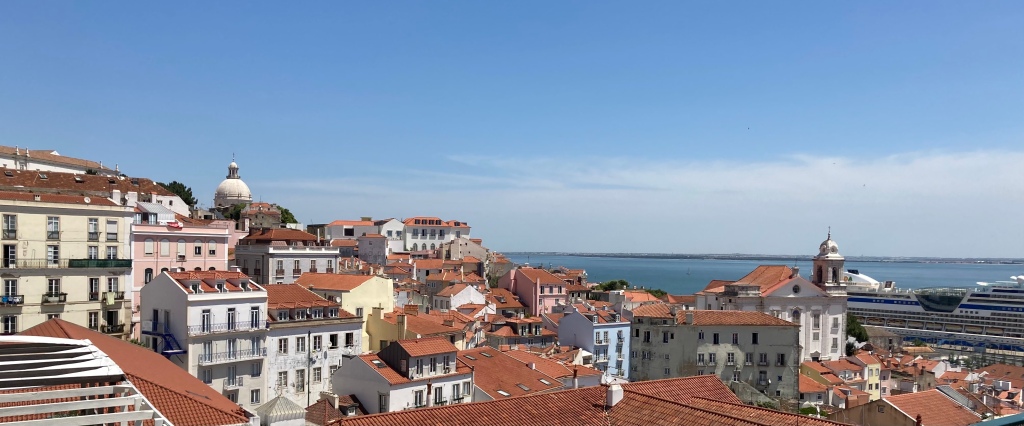
The red tiled roofs of Lisbon’s Alfama district look out over the Tejo river.

I have been living in Portugal for almost six and a half years now. Almost every day I learn something new about this country and its culture. It may be a new word or expression in Portuguese. Or it may be noticing a new flower, fruit, or vegetable. Or just figuring out another aspect of the inevitable bureaucracy that goes with moving to a new country.

When I first moved to a house in a village in central Portugal, I was terrified of driving on the narrow winding roads. I used to grip the steering wheel and hold my breath when a van approached me at speed, wondering if there really was enough room for us to pass each other. Now, I don’t give it a second thought.

I’ve also relaxed when it comes to being overtaken. Portuguese drivers fall into two categories, as far as I have observed. They either drive irritatingly slowly or they do rally driver impersonations. The latter type suddenly appears behind you as you are motoring along a country road minding your business. Then, as you approach a blind corner or a hill, that’s the moment they choose to roar past you. It can be breathtaking!

Banking

Living in the country, I find I use cash a lot more than I used to in the U.S. A lot of the small businesses and restaurants do not accept payment by debit card, multibanco, as they say in Portugal. I even have to pay cash at the garage where I get my car worked on.

Luckily, the caixa automatica (ATM, cash machine or cashpoint in the UK) in Portugal is supremely useful. If you are coming from abroad, you can use your debit card to withdraw euros. If you have a Portuguese bank account you can go to any ATM and get cash without having to pay a fee. The ATM machines here also let you do a number of other operations like paying bills, road tolls, taxes, and fines.

The banking app I have on my phone has a capability called MB Way (multibanco way) which enables me to pay individuals if I have them listed as one of my contacts. I can also pay bills from my phone by using the IBAN number of the payee.

Various useful odds and ends

Here are a few other tidbits I’ve learned or noticed in Portugal.

* Bathrooms: lights may be on timers, so you may be plunged into darkness while you are doing your business  – wave your arms around, which usually activates the lights.

* Toilet paper: a lot of Portuguese homes or businesses are on septic systems which get clogged with toilet paper. They ask you to put the TP in a bin provided. For women it can be hard to re-learn the habits of a lifetime.

* Tickets for many trains and bus trips give assigned seats. If you are 65 years old and older you travel half-price on the trains.

* Portuguese people are not huggers. Expect an air kiss on each cheek even from business people you’ve never met before.

* In big cities the bread, cheese, and olives they put on the table before they bring you your meal are usually not free. The charge can be from one to five Euros. Beware. You can often get a fixed-price meal by looking for the “Prato do dia” or dish of the day. In the small local restaurants in my area the prato-do-dia price is usually as little as 10-12 euros, with wine, dessert and coffee included.

Follow my blog to learn more about daily life in Portugal, and my website, RosalieRayburn.com

Scene along the River Douro in Porto, Portugal’s second largest city.

Life is full of festival fun in Portugal

Rua Serpa Pinto in Tomar is decorated ready for the Festa dos Tabuleiros which runs July 1-10. The festival, held once every four years features the unique processions of young girls carrying huge headdresses along the lavishly decorated streets of the town.

The solstice has just passed and my local town of Tomar is gearing up for the Festa Dos Tabuleiros, or festival of the trays. This unique celebration began in the Middle Ages as a Catholic tradition to honor the Holy Spirit (Espirito Santo). It features processions of young girls and women dressed white, carrying on their heads tall trays that are stacked with bread rolls and flowers and topped with a crown. Each girl is accompanied by a young man or boy to provide help if the load becomes unwieldy. The headdress trays often weigh 20 lbs (9 kg) or more.

This famous festival is held once every four years. I arrived in this part of Portugal days after the last one in 2019, so I am eagerly looking forward to experiencing this one. Friends and neighbors who have lived through this before, warn me that there is no parking anywhere in town. They advise driving to one of the stations a few miles (kilometers) away and taking the train into Tomar.

Spirit of community

Preparations for the festival began months ago. Many expatriates who live in the Tomar area have become active in the groups that get together to make the paper flower decorations that adorn the headdresses. They gather weekly, cut colored tissue paper, twist wires, form the flowers and chat. One woman said she loved the opportunity to get to know some of her Portuguese neighbors and feel more part of the community. Residents of the streets also practice laying out the patterns of branches and flowers that are a distinctive part of the street decorations.

Of course, Tomar is not the only town that has a summer festival. The city of Lisbon celebrates every June 12-13 the festival of Santo Antonio, who is a patron saint of the city. There is music, dancing, and food. Grilled sardines are a very typical Portuguese specialty at this time of year. Other towns and villages also have their own ways to honor various saints.

Residents of the village of Chaos in central Portugal, process carrying a statue of St. Anthony of Padua. The saint is often seen holding the child Jesus.

Portuguese festivals are also occasions for games, music and dancing. I am always amazed at how the crews at these local festivals can produce huge quantities of truly delicious grilled chicken to feed the party-goers. The early part of the evening entertainment at these festivals usually features raffles, simple carnival games (one I saw last year involved pulling a rope to release a rabbit that would then run into a one of a dozen tiny shelters around a circle. Each shelter was numbered. The prize for a winning number was a bottle of wine.)

In the early evening there are also exhibitions of Portuguese dances with dancers in brightly colored traditional clothing. The real dancing usually doesn’t start until at 10 p.m. and goes on until the wee hours.

Colored lights decorate a street during a festival in a village in central Portugal.

Follow my blog to learn more about live in Portugal and read my New Mexico mystery novel, “The Power of Rain.” Available on Amazon.

Summer is festival time in Portugal

From July 1-10 the town of Tomar in central Portugal will celebrate the Festa dos Tabuleiros, or Festival of Trays. This picture shows how girls and their male companions will parade through the streets. The festival takes place once every four years drawing tens of thousands of people to witness a tradition that dates back to the Middle Ages.

Summer is the season for celebrating all over Portugal. Villages, towns and the big cities hold festivals in honor of saint’s days or ancient spiritual traditions or just to have fun!

Tomar, my nearest town, will be holding the Festa dos Tabuleiros, or Festival of Trays, from July 1 to July 10. Held every four years, the festival draws hundreds of thousands of visitors to this small central Portuguese town. Young girls dressed in white carry headdresses made of bread rolls and flowers topped with a crown. They process through streets festooned with garlands of flowers. Some of the headdresses are more than five feet (1.5m) tall and weigh up to 20 lbs. (9 kg). The tradition started in the Middle Ages as a religious festival honoring the Espirito Santo (Holy Spirit), according to my Portuguese teacher.

Santos Populares

The big cities of Lisbon, the capital, and Porto in the north, hold popular saint’s festivals in June. Lisbon’s festival is the Festa de Santo Antonio, in honor of St. Anthony, on June 12 and 13. Neighborhoods all over the city are decorated with flowers and wreathes. The air is filled with the scent of grilled sardines, chorizo, and music is everywhere. People dance, drink beer and wine and stay up to the wee hours.

Porto hold s a festival June 23-24 in honor of São João (St. John). As with so many other festivals, this one is hundreds of years old and has pagan origins. It was originally a time to celebrate the sun and good harvests. It later became Christianized but food, fireworks and bonfire customs persist.. During the festa de São João you will see tubs of “Manjericão” or basil everywhere. You should also arm yourself with a plastic hammer. For some reason it is traditional to hit everyone you meet in the street on the head with one of these hammers. No one takes offense!

Celebrating History

Elsewhere, cities like Torres Novas, hold festivals to show off their historic way of life. The above pictures are from the Medieval Festival in Torres Novas. From left, you can see jugglers, dancers and re-enactors sword fighting. The festival at the town’s castle also had displays of ancient crafts such as spinning, blacksmithing, candle making and cheese making. Of course there was plenty of music and dancing as well.

June is Pride Month

Many countries now hold “Pride” events celebrating the LGBTQ communities during the month of June. Portugal now has pride events in several towns all over the country. Lisbon will hold a major Pride Parade on June 17 and will have a huge street fair on June 24 near the Praço do Comericio beside the river Tejo.

Follow my blog to learn more about daily life in Portugal. Check out my novel “The Power of Rain”, available on Amazon.

Abandoned animals, a sad fact of Portuguese life

These are a few of the dozens of dogs at a privately run animal shelter in central Portugal. Volunteers care for the animals and help them get adopted. More than 43,000 animals were abandoned in Portugal in 2022, according to an official report.

Abandoned animals are an unfortunate fact of life here in Portugal. The municipal and private shelters are always crammed and desperately in need of more volunteers to help care for the animals and donations to cover the cost of food and vet bills.

I have been living in Portugal for nearly four years now. I frequently see dogs wandering the streets of the villages. Cats are everywhere. My next door neighbor regularly feeds four or five of them. I see their eyes glowing in the dark when I take my dog out for her last night pee walk.

In fact my own dog was abandoned in my village a few days before I move into my house. I used to have two cats in the US but was unable to bring them because I had no fixed abode for the first couple months I was here. I did find them a very good new cat-mommy, but I firmly intended to get more cats when I settled in.

The universe had other plans. Divina was wandering the street, sleeping on a doorstep. I saw her and offered her some bread and milk and hey presto! I had a dog.

Divina, the podengo mix female dog who was abandoned and adopted me once I moved into my house in Portugal.

Not all dogs are so lucky. (At least I think Divina is lucky. I feed her, walk her multiple times a day, and adore her.) According to an official report by the ICNF (institute for conservation of nature and forests), 43,600 animals were abandoned in Portugal in 2022. That works out to 119 per day.

The report said conditions during the Covid pandemic greatly worsened a longstanding problem. Many Portuguese struggle to make ends meet and the care and feeding of animals is often not a priority. On top of that, it is relatively expensive to have a veterinarian neuter dogs or cats so the practice is not common. Hence, there are thousands of unwanted litters of puppies and kittens.

I walked out one morning in October 2021, about to take Divina for a walk, and heard a little bark from somewhere inside my gate. I searched around and found source of the sound under my car. It was a tiny puppy. I guessed he was maybe eight weeks old. Just weaned from his momma.

Someone dropped this adorable little puppy over my wall one night in October 2021. I was able to find an American family to adopt him.

Many Efforts to Re-home Animals

There are resources to help the abandoned animals. There are 170 official collection centers for abandoned animals located in municipalities all over Portugal. However, they are often very crowded. The animal shelter outside of Tomar, my nearby town, had more than 100 dogs when I volunteered there in early 2020. My work as a volunteer consisted of sluicing out the pens. The constant sound of barking from all these animals was overwhelming.

Sadly, when the Covid pandemic restrictions took effect, I and other volunteers could not longer help there, though this situation has since changed.

I recently helped out at a privately run dog shelter. Pegasus e Bigodes, near Figueiro dos Vinhos. It is a non-profit started by a Dutch woman and run by volunteers. It operates out of a house where supplies are stored. All around the house are enclosures built by volunteers. When I went there recently they had about 40 dogs. Volunteers walk and feed the dogs, clean the pens and help to find adoptive homes for the animals. They raise funds through stalls at local markets. A man who runs a consignment store donates a part of his proceeds. But they really need volunteers and donations and volunteers. (Hint, hint.)

Follow my blog to learn more about daily life in Portugal! And check out my book “The Power of Rain” on Amazon.

Thoughts on Uvalde, a year later

Morning Glories in my Portuguese garden.

(Author’s note: I wrote this blog post almost a year ago, after I had read about the horrific events at Robb Elementary School in Uvalde, Texas, where 19 young children and two teachers were shot dead. Sadly, so much is still the same. Gun violence has become more prevalent, mass shootings are a near daily occurrence and nothing is done to address the real problem–the prevalence of weapons of human destruction.)

LOSING A CHILD is the most gut-wrenching experience that can happen to a parent. It isn’t supposed to happen. Your children aren’t supposed to die before you. But it does happen sometimes, and we become members of a club no one ever wants to join. 

Their little faces remain forever young in the photos that surround you, haunting you, like phantom pieces of your heart.

I lost my 11-year-old son to a rare and devastating illness many years ago and I am still haunted.

There are so many emotions; pain, despair, rage. The questions; why them? Why now? What did they/I/we do to deserve this terrible thing happening?

When numbness finally comes it is a relief from the pain, but it is always with us, like a severed limb that will never regrow. 

I write this not to gain sympathy but to draw attention to what the parents of those 19 children in the small Texas town are facing. It will affect not only them, but their other children, their nieces and nephews, their grandchildren. It will ripple out throughout the families and neighborhoods, and eventually to the next generation.

The parents in Uvalde will live the rest of their lives asking the questions. And the terrible thing is; that despite so many of these hideous incidents, and their increasing frequency….. NOTHING substantial has been done to prevent them. Why the lack of courage to make change? Americans pride themselves on living in the land of the free. Where is the freedom in having to go to school surrounded by armed guards? Having to live in constant fear?  Is that freedom? 

I moved to Portugal three years ago and feel safer and more free here than I ever did in the US. 

My son Max: February 18, 1988-June 6, 1999.

Loving the marvelous markets of Portugal!

The indoor market in Tomar is open daily, but Fridays are the main market day when the plaza around the indoor market is filled with vendors of clothing, shoes, kitchen equipment, tools, garden supplies and furniture.

Visiting local markets is one of my favorite things to do in Portugal. It’s a wonderful opportunity to immerse yourself in the local community. I love hearing the market sellers calling out their wares and the hubbub of people crowding around the stalls.

Markets are an age-old tradition in Portugal. Every town has its regular market day. In days gone by it was the only way people could buy items they didn’t grow themselves. Nowadays, market day is the still the time when residents shop for fresh produce and take the opportunity to meet and chat with their neighbors.

My village, Chãos, (roughly pronounced shah-oosh) has a market every Sunday morning. The indoor market area features vendors from two different bakeries, a fish seller, two butchers, two vegetable stands and a stand that specializes in cheeses, bacon and chorizo sausage. On the plaza outside, there are a couple of ladies selling vegetables and olives and a van that has linens.

If you are hungry, there is couple that sells grilled chicken and fries. Or, you can get coffee and a drink in the tiny cafe inside at the back of the market and another upstairs in the community hall. It’s a great time to meet friends.

Pots, pans and live chickens

The second Sunday of the month is the “big” market in Chãos and the plaza is covered with vendors. That’s when you can buy a pair of jeans, sneakers, pots and pans, tools, live chickens and ducks, plants and young fruit trees, and the distinctive terra cotta colored Portuguese pottery.

One of the fish stands at the indoor market in Tomar, central Portugal. Portugal is the country with the highest fish consumption in the European Union, according to the US Dept. Of Agriculture.

Towns around where I live have their own different market days. Tomar, a town of about 22,000, holds its market on Fridays. Its market covers several acres in the center of town. One of the things I like best about the Tomar market is the stands selling dried fruit and nuts. You can buy quantities of walnuts, almonds, dried figs and apricots. There is even a variety of items like Chia or sesame seeds and quinoa!

The other towns near me, Ferreira do Zezere and Freixanda, hold their markets on Mondays. So, I have plenty of choices to indulge my love of markets. The prices are always great. I load up on vegetables, buy plants for my garden and have also scored a slinky pair of jeans and some lovely sheepskin slippers!

Pistachios nuts, chia seeds, sunflower seeds and different types of grains are available at this stand at the indoor market in Tomar.

May is pilgrimage season in Portugal

A floral pattern on the paving stones in the village of Chaõs in central Portugal. Foral patterns are a common site during the many religious festivals and processions that occur during the summers in Portugal.

Pilgrims were on the move this week in Portugal. Huge crowds of walkers, clad in high-visibility vests lined the country roads heading to the town of Fatima. May 13 marks the day in 1917 when the Virgin Mary is said to have appeared to three shepherd children in a field outside of the town. The children; Lucia, Jacinta and Francisco said they saw her several more times. The last time was on October 13, reportedly witnessed by 70,000 people.

Nowadays, the ornate Basilica of the Rosary of Our Lady of Fatima dominates a vast plaza around the site of the original apparitions. Hundreds of thousands of visitors come here each year.

This week I was on a cycling trip through an area of central Portugal near Fatima. My fellow cyclists and I saw several pilgrim groups. They were happily chatting and laughing, waving at us as they strolled along the country roads in their brightly colored vests.

My Portuguese teacher, Helena, recalls making the pilgrimage in her youth. She said she and her parents walked “dozens of kilometers”. They had to reach Fatima by the night of May 12 so they could take part in the traditional candlelight procession. She mostly remembers how cold and exhausted she was during the night spent there.

Many Ways

There are several “official” routes waymarked with blue signs. The 141-km Tagus Way starts at the Parque das Naçoes in Lisbon and continues along much of the same route as that which leads toward Santiago de Compostela in Spain. The Northern Way is a 260-km route beginning in the town of Valença on the Spanish border. The 111-km Coimbra route begins in the university city of Coimbra. The Nazaré Way starts in the coastal town of Nazaré which has a shrine of its own to Our Lady.

Olive trees and poppies are a common sight along the pilgrimage routes to Fatima in central Portugal.

Follow my blog to learn more about daily life in Portugal. Check out my mystery novel “The Power of Rain” on Amazon.

My book is an Award Winner!

I was so excited to get an email from the National Federation of Press Women this week with this news.

Every writer dreams that readers will love their book. This week I got one of my wishes! An email arrived from the National Federation of Press Women letting me know my debut novel “The Power of Rain” was awarded Third Place in the 2023 NFPW At-Large Communications Contest.

The National Federation of Press Women is a US-based organization of professional women and men working in all types of communications, including broadcast and print Journalism, PR marketing advertising and more. The book was inspired by many of the weird and wonderful situations I experienced during the 18 years I was a staff writer for the Albuquerque Journal in New Mexico. Many states have their own state-based contest, but since I am no longer living in New Mexico I had to enter the “at-large” contest.

Receiving this award is a real validation of my instincts as a writer.

The Power of Rain– the story

Passions clash in Las Vistas, a Southwest desert town where money buys power and corrupt politicians turn a blind eye. Elizabeth “Digger” Doyle is a tough young reporter investigating Johnny Raposa a shady developer who wants a road built to his luxury new subdivision. Hispanic activist Maria Ortiz begs Digger to save her heritage, a historic Spanish chapel that lies in the path of the road. Digger’s investigation into Raposa’s past is complicated by her powerful attraction to Maria.

As the two navigate a tightrope relationship fellow reporters warn Digger she’s risking her career by getting involved with a story source.

Can Digger get the story without losing Maria’s trust? Can she expose Raposa and stop the bulldozers before they destroy the chapel?

I published the book in June 2022 and have been working hard since then to market it. I have received a lot of good feedback in the reviews on Amazon and in other places.

What the judges said:

A strong sense of place pulls the reader immediately into the story. Characters are fully developed. Good dialogue.

Action, conflict and resolution are well-represented in this novel, creating a smooth delivery of a mystery dealing with contemporary topics.

National Federation of Press Women contest judges – (fiction for adult readers category)

Readers reviews

This book gave me sleepless nights….quite literally. I usually like to read a chapter or two of something before I go to sleep, and this was so darn good that I kept finding myself up until two in the morning finding out what happened next!

Written with a deep knowledge, both of the setting, New Mexico, and the background, local journalism, Rosalie Rayburn has got a winning formula here.

Amazon Customer

Another Amazon Customer: Set in a city in the New Mexico desert, this novel has all the characteristics of a page-turner –romance, underhanded or bewildered City officials, journalists at work to shine light on bureaucratic dealings, nefarious developers and the power of local people who keep showing up and speaking the truth.

Michael Rothrock, The Book Commentary: Rosalie Rayburn’s The Power of Rain contains expertly crafted prose that pulls off the seemingly impossible by making small-town politics a page-turning subject matter. The protagonist is well-developed and leads a life filled with enough turmoil and intrigue to keep the reader on the edge of their seat as she navigates a complicated relationship, a journalistic mystery, and uncertainty regarding her employment. Raposa is an antagonist equally well-developed that the reader will love to hate for his hidden motives and arrogance. Filled with intrigue and suspense, mystery fans will love The Power of Rain

A new book coming soon

Over the past year I have been working on a sequel to The Power of Rain. Many of the friends who gave me encouragement and support during the writing process said they wanted to hear more about what happened to my main characters (Elizabeth) Digger Doyle and Maria Ortiz. The new book is called “Sunshine Dreams” and I hope it will be published by the end of 2023.

I’m not going to give the plot away, but I will say that it’s another story about political intrigue, intrepid reporting and REVENGE!

Follow my blog for more news about life in Portugal. Check out my website: rosalierayburn.com

Portugal celebrates nearly 50 years since the Carnation Revolution

The evening news on April 25 shows people dancing in the streets of Lisbon, all part of the celebrations for the 49th anniversary of the Carnation Revolution in 1974, a nearly bloodless coup which ended 40 years of authoritarian rule in Portugal under Antonio de Oliveira Salazar. (Note the man in the bottom right of the picture. Portuguese news programs always have someone signing.)

Dancing in the streets, parades, singing and joyful speeches. Portuguese people turned out everywhere last week to celebrate the 49th anniversary of the Carnation Revolution, which ended a decades-old dictatorship.

Portuguese people have a lot to be proud of. They endured more than 40 years of a brutally repressive regime which began in 1932 and ended in 1974. During the “Estado Novo” which was created by Prime Minister Antonio de Oliveira Salazar, there was strict censorship of the press, books, music and arts. People lived in fear of being reported to the secret police, the PIDE (Policia International e de Defesa do Estado). Thousands were arrested, tortured and imprisoned during those years.

Salazar was a staunch supporter of Portugal’s colonies; Angola, Mozambique, Guinea Bissau, in Africa, Goa in India and Macau in China. In the early 1960s Portugal sent troops to quell independent movements in the African colonies. These colonial wars were very costly and unpopular. Many Portuguese fled their home country to go work in France so they didn’t have to participate in those conflicts. (When I moved to Portugal in 2019, I quickly found that many older Portuguese speak fluent French from their years there.)

Salazar suffered a debilitating stroke in 1968, was replaced as prime minister by Marcelo Caetano, and died in 1970. Meanwhile, many of the lower ranking officers serving in Africa began planning to overthrow the dictatorship. The Portuguese Communist Party (PCP) was also active in organizing opposition.

Popular song gave the signal

On April 25, a song played on the radio, “Grandola Vila Morena”, was the signal for the armed forces, with widespread popular support, to overthrow the regime. The coup gained its name because people in the streets handed red carnations to the soldiers who put the flowers in their gun barrels or on their uniforms. Within a few hours Caetano had resigned and the Estado Novo came to an end with hardly a shot fired.

Children and their teachers participate in parades in Lisbon during celebrations on April 25 to honor the 49th anniversary of the Carnation Revolution.

Soon after the overthrow of the regime, the former colonial countries in Africa began their own struggles to complete the transition to independence. Back in Portugal a major symbol of the change was the renaming of the iconic bridge across the river Tejo in Lisbon from the Salazar Bridge to the 25 April Bridge.

The 25th April Bridge (Ponte 25 de April) over the River Tejo in Lisbon. It was designed by the consortium that constructed the Golden Gate Bridge in San Francisco, Calif.