
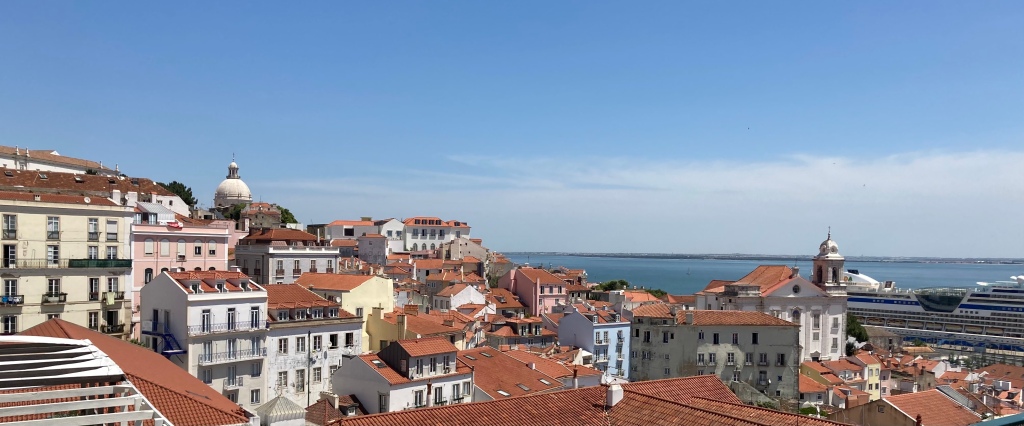
Splashing fun in Portugal’s river beaches

Agroal, a river beach on the Rio Nabão in central Portugal has a separate pool area as well as the sandy beach areas along the river.

The beach is the place to be during Portugal’s hot summer months. Yes, you can go to the popular, crowded, coastal spots. The beaches of the Algarve and the Alentejo attract thousands of tourists. But you don’t have to go to the coast. Portugal is also famous for its river beaches.

What is a river beach?

You may well ask. Think of it this way: wide stretches of sand accumulate on the bends as a river winds its way to the sea. Many of these sandy spots have been turned into beach attractions. Yup, there they are, complete with umbrellas, restaurants, water sports and vendors selling inner tubes and other colorful floatation devices.

Some river beaches are more like swimming pools, created by diverting a portion of the river between walls where the shallow water is accessible by stairs.

“River beach” near Lousã castle in central Portugal.

The river beach beside Lousã castle is near a hiking trail that meanders through the Shist Villages (Aldeias de Xisto). These remote historic villages are built from a type of stone known as shist.

Many river beaches have picnic tables where families can come and enjoy refreshments while they loll in the sun. A word of warning, the water is often breathtakingly cold. Still, a lot of people risk a dip just to cool off when the thermometer climbs over 30 degrees C. (86 F).

A river beach along the Rio Mondego between the city of Coimbra and the town of Penacova.

Kayaking is another popular activity. The 18-kilometer route down the broad, slow-moving Rio Mondego from near Penacova toward Coimbra is a great day adventure.

Follow my blog to learn more about daily life in Portugal. Check out my website to read all about my mystery novels. rosalierayburn.com

Portugal is eco-friendly in many ways

An ancient Roman bridge in central Portugal.
Spring flowers cover the surface of a stream near an ancient bridge in central Portugal.

Follow my blog to and check out my website: RosalieRayburn.com

Eco-friendly shopping

In Portugal, the supermarkets and small grocery stores do not bag your groceries. You must bring your own shopping bags or buy one at the checkout. The bags you buy are large and sturdy so you can fit a lot into one bag. You yourself must stuff all the items you have bought into the bag at the checkout. This saves a mountain of plastic bags from ending up in landfills. I was saddened to see that in Albuquerque, where I used to live, the city council reversed a decision to ban those plastic bags. 

Another practical innovation is the way you use shopping carts. They are typically linked together and you must insert a coin or a plastic token to release the cart to take it into the store. After you’ve unloaded your shopping, you return the cart, reconnect it and you get the coin or token back. 

This is a simple way to ensure that carts are returned. In Albuquerque I was used to seeing shopping carts abandoned all over the place. On a windy day a rogue cart could damage your car. It was also probably a big expense for the supermarkets to lose them.

An ancient bridge near Lousã castle, central Portugal. The pool is used for swimming in the summer.

Bathroom etiquette

In a lot of private homes, restaurants and even small hotels in Portugal, it is common to see a sign asking you not to put any paper or other products into the toilet. In private homes it’s because they have a septic system that can’t handle large volumes of toilet paper. I’m assuming the restaurants etc have some similar problem. Anyway, you have to re-train yourself to put the TP into the small container next to the toilet. It took me a while to be consistent about this. 

I have even found some bathrooms, such as at a train station or a shopping mall, where you have to grab a length of TP from a huge roll hanging on the wall by the sinks, BEFORE you go into the stall.

Of course men rarely have either of these problems.

A couple of other points about bathrooms. Most toilets in Portugal have dual flush options which save water. Bathrooms typically have hot air blow dryers instead of paper or cloth towels to dry your hands. 

Time and temperature confusion

After nearly five years of living in Portugal, I have become  bi-lingual in matters of time and temperature. I am no longer flummoxed when trying to decide whether to take the train at 17:00 or 19:00, hint 5 p.m. or 7 p.m. Saying a.m. and p.m. seems so inefficient. Here you know immediately whether you’re talking about 12 noon (12:00) or midnight (24:00) .

I’ve also adjusted to using Celcius versus Fahrenheit referring to the weather. I’ve become used to thinking that 20 degrees C (68F) feels pretty comfortable and 40 degrees C (104F) is nigh-on unbearably hot. Returning to the US and reading that it’s 21 degrees I have to do mental gymnastics to remember that is really cold! Or, I could just stick my nose outside!

How far is that?

I must confess, I have not adapted so well to using kilometers versus miles, or kilograms instead of pounds. I used to be a very enthusiastic cyclist in New Mexico. There are mountains in NM but there are a lot of opportunities to ride on flat ground too. A 30 mile flat ride was considered pretty easy. I live in a hilly area in central Portugal and it is hard to find flat routes. Hence, a 30 km (18.6m) ride in my area is pretty tough!

I have to use grams and milliliters for European cooking recipes but I keep my bathroom scales on pounds so I still can’t tell you what I weigh in kilos. (I probably wouldn’t anyway!)

Cycling in the hills of Figueira dos Vinhos
Cycling in the hills near Figueira dos Vinhos, central Portugal.

Celebrating 50 Years of Democracy in Portugal with flowers and a song

A banner image of a carnation decorates the city hall in Grândola, as part of the celebrations for the 50th anniversary of the Carnation Revolution in 1974.

(Grândola, Portugal) Fifty years ago this week, the Carnation Revolution of April 25 1974, ended more than forty years of a brutal dictatorship in Portugal. The Portuguese celebrated the anniversary with marching bands, parades, flowers and an iconic song–Grândola Vila Morena.

This song, by José “Zeca” Afonso, was played on the radio as a signal to the Armed Forces Movement (MFA) to begin the coup. Captain Fernando José Salgueiro Maia is remembered as a hero of the day for facing down forces loyal to the government led by Marcelo Caetano.

By the evening of the 25th, the coup succeeded and Caetano resigned without blood being spilled. Instead, the brilliant red carnation became the image of the revolution when a restaurant worker, Celeste Caeiro, gave a flower to a soldier who put it in the muzzle of his gun and–to use a 21st century phrase–it went viral!

Night and Silence during the dictatorship

The years of the Estado Novo, from 1933 to 1974, were grim for the Portuguese people. Under the stern and autocratic António de Oliveira Salazar, and his successor Caetano, thousands of people were imprisoned and tortured, women were subservient, unable to even open their own letters, and public gatherings were banned. Even Coca Cola was prohibited lest it threaten the Portuguese wine industry.

Portuguese poet Sophia de Mello Breyner Andresen expressed the deep joy as the country emerged from this dire period with the words”

“Esta é a madrugada que eu esperava, O dia inicial inteiro e limpo, Onde emergimos da noite e do silencio.

Rough translation: This is the dawn I longed for, the first day complete and clean, when we emerge from the night and silence”

A marching band plays “Grandola Vila Morena” at a flag ceremony in the town of Grandola on April 25, 2024, the 50th anniversary of the Carnation Revolution that ended a decades long dictatorship.

Disturbing /new trend

Despite the joyful celebrations, a recent election showed Portugal, like other European nations, is trending to the right. Throughout most of the past fifty years, Portugal has had centrist or mildly socialist governments. In 2019 a new hard right party, Chega, appeared. That year it received a mere 1.3 percent of votes. But it has steadily gained in popularity. In an election held March 10 this year, it received 18 percent of the votes.

50th Anniversary of the Carnation Revolution on 25 April, 1974.

Follow my blog to learn more about daily life in Portugal and check out my website: RosalieRayburn.com and my Digger Doyle Mysteries.

Portugal Celebrates 50 Years of Democracy

Dancing in the streets on April 25, 2023, bigger celebration planned this year.

Next week Portuguese people throughout the country will celebrate the fiftieth anniversary of the Carnation Revolution. The bloodless event freed this small nation and allowed it to move forward with the rest of Europe.

Portugal endured more than 40 years of a brutally repressive regime which began in 1932 and ended in 1974. During the “Estado Novo” which was created by Prime Minister Antonio _de_Oliveira_Salazar , there was strict censorship of the press, books, music and arts. People lived in fear of being reported to the secret police, the PIDE (Policia International e de Defesa do Estado). Thousands were arrested, tortured and imprisoned during those years.

Women unable to open their own mail

Conditions for women under the dictatorship sound similar to present day Afghanistan under the Taliban. The teacher at the Portuguese classes I have attended told us that during that period women were not allowed to travel, work outside the home or open their own mail without their husband’s permission. Groups of people were not allowed to gather together in public. Coca Cola was forbidden because Salazar believed it might threaten Portugal’s wine industry.

Colonial Wars

Salazar was a staunch supporter of Portugal’s colonies; Angola, Mozambique, Guinea Bissau, in Africa, Goa in India and Macau in China. In the early 1960s Portugal sent troops to quell independent movements in the African colonies. These colonial wars were very costly and unpopular. Many Portuguese fled their home country to go work in France so they didn’t have to participate in those conflicts. (When I moved to Portugal in 2019, I quickly found that many older Portuguese speak fluent French from their years there.)

Salazar suffered a debilitating stroke in 1968, was replaced as prime minister by Marcelo Caetano, and died in 1970. Meanwhile, many of the lower ranking officers serving in Africa began planning to overthrow the dictatorship. The Portuguese Communist Party (PCP) was also active in organizing opposition.

Popular Song Gave the Signal

On April 25, a song played on the radio, “Grandola Vila Morena”, was the signal for the armed forces, with widespread popular support, to overthrow the regime. The coup gained its name because people in the streets handed red carnations to the soldiers who put the flowers in their gun barrels or on their uniforms. Within a few hours Caetano had resigned and the Estado Novo came to an end with hardly a shot fired.

Soon after the overthrow of the regime, the former colonial countries in Africa began their own struggles to complete the transition to independence. Back in Portugal a major symbol of the change was the renaming of the iconic bridge across the river Tejo in Lisbon from the Salazar Bridge to the 25 April Bridge.

The iconic April 25 bridge over the river Tejo in Lisbon.

Follow my blog to learn more about daily life in Portugal. Check out my website RosalieRayburn.com to read all about my Digger Doyle mystery novels.

Exploring Portugal’s Douro River Valley

A cruise ship gliding up the Douro river near Regua. The steep, terraced hillsides in many areas are planted with grapevines.

I’ve been living in Portugal for four years now but I had never been to the Douro Valley until this week. I made the visit thanks to some English friends who stayed a few nights with me then wanted to venture on northward to see the area where the grapes used to make the famous Port wines are grown.

We set off in the beautiful campervan that they have used to travel from England, via ferry to Spain. They are intrepid travelers, coping with living for weeks in this tiny space on wheels as they explore the length and breadth of Spain and Portugal. They avoid the expensive and mindless toll roads and opt for routes that lead them through colorful towns and villages. Sometimes ending up in streets so narrow they’ve had to pull in their side mirrors and pray they don’t get stuck.

The Dão wine growing region north of Coimbra

Our route took us from my home near the central Portuguese town of Tomar, past the famous university city of Coimbra to head northward. We stopped to picnic by a river in the Dão wine growing area. Here the villages were bright and well-kept and the hillsides were covered in neatly pruned grape vines. In the distance to the east, we could see the snow-capped ridge of the Serra d’Estrela, Portugal’s mountain range.

Continuing north, we passed through the bustling city of Viseu. Beyond that we traveled over hills and through immense, steep-sided valleys. Despite the remoteness, the area was well-populated. Another busy town we passed through was Lamego which has an impressive church atop a long series of steps.

The Santo Estevão hill leading to Nossa Senhora dos Remédios church, Lamego in northern Portugal.

Douro Valley by train

Our goal was to reach the town of Régua on the Douro river where we could get a train to Porto. We parked the van near the train station and caught the regional train headed to Porto. Heading west, the train follows the river course for about an hour. The views of the terraced vineyards overlooking the river are magnificent.

It takes about two hours by train to reach the São Bento train station in the center of Porto. If you want to make a day of it, you can take the train from Porto heading east and go all the way up river to Poucinho.

A statue of the famous “Sandeman” port label image stands atop a hillside opposite the town of Régua.

The famous Ports of Porto

Porto, or Oporto, is Portugal’s second largest city. It is probably best known for the fortified red wines that bear its name. Apparently, a tax applied to French wines in the 17th Century led the wine-loving British to look for other sources. Slowly but surely, English entrepreneurs established themselves in the growing and production of the wines from the Douro valley.

Port is a “fortified” wine, containing a higher amount of alcohol than normal red wines. This is achieved by adding a proportion of distilled alcohol, “Aguardente” (a type of Portuguese brandy) to the wine to stop the fermentation to preserve the sweetness and richness of the flavor.

Grahams, Calem, Kopke and Taylor’s are among the famous Port names that have their production facilities along the south side of the river in Vila Nova de Gaia. We toured the Taylor’s port lodge.

The self-guided tour of the Taylor’s port lodge cost 20 euros and took about an hour. The visitor’s center opens at 10 a.m. There is a tasting after the tour and you can buy port wines in the on-site shop.

Follow my blog to learn more about life in Portugal. Check out my website RosalieRayburn.com to find my mystery novels.

These flat-bottomed “rabelo” boats were traditional used to bring barrels of port wine down the fast-flowing Douro river.

Unusually wet spring: the new normal?

Rivers throughout Portugal are running high after weeks of rain.

I’ve said this before, but I’ll say it again: It rains a LOT in Portugal.

November and December are typically the wettest months, but the last few weeks have reminded me of a week I spent in Bali during the rainy season. Okay, we have had a couple of days of sunshine here and there. And it hasn’t rained all day every day.

Last week we did see temperatures climb to around 26 C (78F), but a sandstorm in the Sahara sent dust our way and the skies remained stubbornly hazy. My car was covered in the fine brown dust. However, before I could think about washing it, the weather changed again.

This week the temperatures in my part of central Portugal have been in the 10C – 12C range (50F – 54F), and the rain has been incessant. Areas further north, like the Serra d’Estrela, are expected to get snow. The forecast is that this will last through Easter.

Wetter, colder in the north

Unsurprisingly, northern Portugal experiences colder and wetter weather. The Minho area near the Spanish border, cities like Braga and Bragança are typically much colder than the southern regions of Alentejo and the Algarve. Braga averages about 57 inches of rain annually, Porto 45 inches and Lisbon 31 inches, while the Algarve averages 20 inches.

Just as in areas of the southwestern United States, rainfall in the Algarve has led to a serious drought problem. The mayor of a city near Faro has said the situation is becoming “catastrophic.”

However, you’d never guess that if you visited some of the fancy vacation resorts that feature emerald green golf courses and lush landscaping. Nevertheless, the Portuguese government is expected to introduce wide ranging water saving measure.

I wish I could send some of the rain tipping down on my property to the Algarve. But I should be grateful because the rain brings out beautiful spring flowers!

Follow my blog to learn more about daily life in Portugal. And check out my website: RosalieRayburn.com for information about my Digger Doyle mystery series.

Irises are growing wild all around me in central Portugal.

Elections show Portugal’s drift to the right

This statue overlooks the Praça do Comercio in Lisbon. The two hands of the statue are a metaphor for the longstanding balance in Portuguese politics, but that is changing as the recent election showed a shift to the right.

Portuguese elections held last Sunday, March 10, yielded a razor-thin majority for the Democratic Alliance party. But the DA lead was only two seats more than the Socialist Party so forming a government will be a delicate balance, according to reports.

More revealing was the strong showing of the far-right Chega party which gained about 18 percent of the votes. That’s up from 7.2 percent just two years ago.

In 2019, the year the party was launched by former football commentator André Ventura, it garnered just 1.3 percent of the votes cast.

The DA leader Luis Montenegro has publicly stated that he does not want to include Chega in a governing coalition. Still, expectations are high that Chega (Enough) will play some kind of role in the balancing act.

The snap election was called in November after former Socialist Party Prime Minister António Costa resigned following a corruption scandal. Turnout in Sunday’s election was 66 percent, which was the highest in several years, according to a BBC report.

The many Chega billboards that appeared all over the country showed Ventura’s face and an anti-corruption message calling for a clean-up in Portugal.

Most support in the Algarve

Election results showed Chega drew its highest level of support from voters in the Faro region in the Algarve. It’s the area along Portugal’s southern coast, home to numerous golf courses and upscale resorts which have long attracted tourists from northern Europe.

It is also an area where there are great discrepancies between local families and the well-heeled visitors.

Several other European countries such as Finland, Italy and Greece have experienced a shift to the right in recent years. It remains to be seen what will happen in Portugal.

Meanwhile, next month the country will be celebrating the 50th anniversary of the Carnation Revolution on April 25, 1974. The bloodless revolution marked the end of more than four decades of authoritarian rule. During that period, according to my Portuguese teacher, there were many informers and thousands of people were arrested, thrown into prison and tortured.

Portugal has been proud of its democratic tradition since 1974.

Follow my blog to learn more about daily life in Portugal. And check out my website: RosalieRayburn.com to read all about my Digger Doyle mystery novels.

Behind me is the April 25 Bridge which spans the Tejo river in Lisbon. It is named in honor of the 1974 Carnation Revolution.

Portugal heads to the polls

Portuguese Prime Minister António Costa gives a televised address.

Portugal is holding an election on Sunday, March 10, barely two years after the last national election. The past two years in Portuguese have been marred by corruption scandals. One of the most prominent involved the country’s flagship airline TAP.

A scandal which erupted in November 2023 involving numerous top officials close to the Prime Minister António Costa was the last straw. Costa resigned, even though he was not directly implicated, and Portuguese President Marcelo Rebelo de Sousa called for a snap election.

Voters will be casting ballots to elect members of the Assembly of the Republic to the 16th Legislature of Portugal. All 230 seats to the Assembly will be at stake.

Compared to the seemingly endless razz-a-ma-tazz of the US election system, Portuguese elections are relatively low-key. However, they are complicated.

The country has multiple parties, ranging from the far-left Portuguese Communist Party (PCP) to the right-wing Chega party. Costa belongs to the Partido Socialista (PS), a center-left party which won 41.4 percent of the seats in the 2022 election.

Still, some of the issues are similar. Portugal has seen house prices soar in recent years. The price of food and fuel has also risen steeply and there are concerns about staff shortages in the country’s national health system.

Right wing party growing

In the 2022 election the relatively new Chega party won 7.2 percent of the votes, up from 1.3 percent in 2019. Launched in 2019 by André Ventura, Chega, which means “enough” in Portuguese, is a populist hard right party.

For the past several months I have been seeing billboards and posters featuring Ventura’s face in cities as far afield as Viana do Castelo in the north to my local town of Tomar, in central Portugal. One of the billboards says “Portugal needs cleaning out.”

I followed a lot of local elections in the US as a reporter in New Mexico, and I will pop into my local polling place for a look at the action on Sunday, but I am not allowed to vote here.

A billboard from the center left-wing Coligação Democrática Unitária stands beside a bridge over the river Nabão in Tomar, central Portugal. The messages say, “Down with injustices.” And “The right to housing.”

Subscribe to follow my blog to learn more about life in Portugal. Check out my website RosalieRayburn.com where you can read all about my latest mystery novels.

Adventures in book signing and selling

Signing copies of my new book, The Sunshine Solution.

Lots of people dream of writing a book. Somehow the idea of being an author is glamorous. Now that I have tasted that dream, I can say that it is hard work and sometimes very frustrating. Still, if you love to tell stories you will inevitably be driven to writing.

I was delighted this weekend to have two events where I talked about my new book, The Sunshine Solution, and signed copies for everyone who bought one. I also sold many copies of my first book, The Power of Rain. I hope that all those who bought one of my books will enjoy them and become loyal fans and rate them on Amazon.

Book event at Treasure House Books in Albuquerque.

How did I get started?

I have always loved telling stories. I told stories to my younger brother as we walked to school in the morning. I was eight and he was six. Later, I told stories to my boys at bedtime. They always clamored for a “make up story”. I suspect much of that was because I would feature them as heroes in the narrative.

Now, I tell stories to my two granddaughters, ages four and two. They also seem to prefer the made up stories better than me reading to them.

In my twenties and thirties I wrote several short stories that were broadcast by Radio Telefis Eireann (RTE) in Ireland. Later, when I was living in Norway, I landed a contract to translate a book of personal memoirs by Norwegians who emigrated to the US in the nineteenth century. When I was living in the Middle East, a British publisher contracted with me to write a business guidebook, “How to Live and Work in Saudi Arabia.”

I also made several attempts at writing a fiction novel, but it wasn’t until a few years ago that I started work in earnest. My first novel, The Power of Rain, came out in 2022. I drew from my experience as a reporter with the Albuquerque Journal covering local government. Believe me, there is plenty of skulduggery to use for a ripping tale.

The Power of Rain was my first “Digger Doyle” mystery.

In that book I introduced readers to the feisty young investigative reporter Elizabeth “Digger” Doyle. When I finished it, friends in my writing group kept saying, “We want to know more about these characters. What happens to Digger?”

Hence, my second book, The Sunshine Solution, which was published in November, 2023. It continues the story of Digger and her girlfriend, the activist/artist, Maria Ortiz, as they are caught up in a political scandal.

Both my books are set in New Mexico.

So, now I am busy at work on my third book, which will continue what has become a series of “Digger Doyle Mysteries.”

Booksigning at the Martha Liebert Library in Bernalillo, NM.

Follow my blog to learn more about daily life in Portugal and check out my website, RosalieRayburn.com, for news about my books.

Five things I learned about life in Portugal

Standing beside the Tejo river in Lisbon with the April 25th Bridge and Cristo Rei statue in the background at the start of my Portuguese adventure in 2019.

I’ve been living in Portugal for more than four years now. I fell in love with the country and its people during my first visit in 2011 and I am still hopelessly smitten.

In recent years, Portugal has gained a lot of attention as a desirable retirement destination. I see a lot of people posting on the various expat Facebook groups asking questions about where they should live. My answer is always: visit the country in person. Internet research is helpful, but nothing compares to a first-hand experience!

That said, I will share a few quirky little tidbits I have learned about life in Portugal over the past four years. So, here goes.

Climate surprises

Portugal has a reputation of being a sunny warm country. Yes, the southern areas of Alentejo and The Algarve are typically hot and dry. But other areas not so much.

Guess what? It rains in Portugal. Sometimes it rains a lot. In the central and northern parts of the country–roughly from Lisbon north–the climate is much wetter and colder than the hotter, drier south. From my experience, the rainy season starts toward the end of October and lasts until near Christmas. Sometimes it will rain for days on end.

The rain in Portugal is often a heavy downpour–think Costa Rica. And all that moisture means….you guessed it… humidity.

Houses can be cold

A lot of Portuguese houses are not well insulated and they do not have a central heating system. This means they can be cold and damp. This is especially true if you buy an old stone house in the country. As one British expat put it, “A stone house is beautifully cool in summer, and bloody freezing in the winter!”

Almost everyone I have met talks about the problem of humidity. That means mold and mildew. Believe me, it’s not pleasant when you find clothes you haven’t worn in a while smell of mildew! Best advice: open windows when you can and buy a dehumidifier!

Tipping is not required

Having lived a lot of my early life in Europe and elsewhere, when I returned to the US and found that a big tip is expected for every kind of service, I was stunned. I mean, why should you tip at the Starbucks drivethru? Or add 20 percent to the cost of a mediocre meal at a chain restaurant. Anyway, that’s just my opinion.

In Portugal, chain restaurants are not the norm. Most are small, family run eateries which frequently have a regular set price lunch menu for working people. A couple of local restaurants I frequent offer a three-course meal–soup, fish or meat main course and dessert, with wine (Portugal produces so much wine)–for around 10 euros. Less than $12. A tip is not expected. If I give 1 Euro, it is greatly appreciated.

The experience is similar with my hairdresser or when using a taxi.

Toll roads can be expensive

I settled in central Portugal near a charming town called Tomar. Places like the historic university city of Coimbra or the famous surf beaches of Nazaré are about an hour away by car. Lisbon is a 90-minute drive. This is using a freeway or “autoestrada”. The freeways in Portugal are wonderfully traffic-free so you can get to your destination more easily than following the twisting secondary routes. But there is a reason they are traffic-free.

Once I settled, I began exploring, happily using these freeways. I saw gantries referring to tolls, but I never saw a toll booth. After several months I received a series of registered letters. Guess what? I had racked up more than 50 euros (nearly $60) in tolls and fines. Turns out the gantries have sensors that register your license plate. You have to pay the toll at a post office within four days or incur a fine.

My neighbors told me I should get a Via Verde device for my windshield. The device is linked to your bank account and the payment is made automatically. It’s all a learning curve.

Bathroom etiquette

This applies mostly to women. In many places in Portugal you will see a sign above the toilet asking you not to put anything in the bowl. This includes toilet paper. There will be a receptacle beside the toilet. Use it.

I have even found bathrooms where there is a huge roll of TP beside the sinks. You pull off what you need and take it into the stall with you.

One other thing. In many restaurant bathrooms, the light turns on when you go inside. The light may be on a timer. If you are plunged into darkness before you have finished your business, just wave your hands around. The lights are motion activated.

Follow my blog to learn more about daily life in Portugal. And check out my website to get one of my mystery novels.

Children play with bubbles in the Praça do Comércio in Lisbon.