
Five things I learned about life in Portugal

Standing beside the Tejo river in Lisbon with the April 25th Bridge and Cristo Rei statue in the background at the start of my Portuguese adventure in 2019.

I’ve been living in Portugal for more than four years now. I fell in love with the country and its people during my first visit in 2011 and I am still hopelessly smitten.

In recent years, Portugal has gained a lot of attention as a desirable retirement destination. I see a lot of people posting on the various expat Facebook groups asking questions about where they should live. My answer is always: visit the country in person. Internet research is helpful, but nothing compares to a first-hand experience!

That said, I will share a few quirky little tidbits I have learned about life in Portugal over the past four years. So, here goes.

Climate surprises

Portugal has a reputation of being a sunny warm country. Yes, the southern areas of Alentejo and The Algarve are typically hot and dry. But other areas not so much.

Guess what? It rains in Portugal. Sometimes it rains a lot. In the central and northern parts of the country–roughly from Lisbon north–the climate is much wetter and colder than the hotter, drier south. From my experience, the rainy season starts toward the end of October and lasts until near Christmas. Sometimes it will rain for days on end.

The rain in Portugal is often a heavy downpour–think Costa Rica. And all that moisture means….you guessed it… humidity.

Houses can be cold

A lot of Portuguese houses are not well insulated and they do not have a central heating system. This means they can be cold and damp. This is especially true if you buy an old stone house in the country. As one British expat put it, “A stone house is beautifully cool in summer, and bloody freezing in the winter!”

Almost everyone I have met talks about the problem of humidity. That means mold and mildew. Believe me, it’s not pleasant when you find clothes you haven’t worn in a while smell of mildew! Best advice: open windows when you can and buy a dehumidifier!

Tipping is not required

Having lived a lot of my early life in Europe and elsewhere, when I returned to the US and found that a big tip is expected for every kind of service, I was stunned. I mean, why should you tip at the Starbucks drivethru? Or add 20 percent to the cost of a mediocre meal at a chain restaurant. Anyway, that’s just my opinion.

In Portugal, chain restaurants are not the norm. Most are small, family run eateries which frequently have a regular set price lunch menu for working people. A couple of local restaurants I frequent offer a three-course meal–soup, fish or meat main course and dessert, with wine (Portugal produces so much wine)–for around 10 euros. Less than $12. A tip is not expected. If I give 1 Euro, it is greatly appreciated.

The experience is similar with my hairdresser or when using a taxi.

Toll roads can be expensive

I settled in central Portugal near a charming town called Tomar. Places like the historic university city of Coimbra or the famous surf beaches of Nazaré are about an hour away by car. Lisbon is a 90-minute drive. This is using a freeway or “autoestrada”. The freeways in Portugal are wonderfully traffic-free so you can get to your destination more easily than following the twisting secondary routes. But there is a reason they are traffic-free.

Once I settled, I began exploring, happily using these freeways. I saw gantries referring to tolls, but I never saw a toll booth. After several months I received a series of registered letters. Guess what? I had racked up more than 50 euros (nearly $60) in tolls and fines. Turns out the gantries have sensors that register your license plate. You have to pay the toll at a post office within four days or incur a fine.

My neighbors told me I should get a Via Verde device for my windshield. The device is linked to your bank account and the payment is made automatically. It’s all a learning curve.

Bathroom etiquette

This applies mostly to women. In many places in Portugal you will see a sign above the toilet asking you not to put anything in the bowl. This includes toilet paper. There will be a receptacle beside the toilet. Use it.

I have even found bathrooms where there is a huge roll of TP beside the sinks. You pull off what you need and take it into the stall with you.

One other thing. In many restaurant bathrooms, the light turns on when you go inside. The light may be on a timer. If you are plunged into darkness before you have finished your business, just wave your hands around. The lights are motion activated.

Follow my blog to learn more about daily life in Portugal. And check out my website to get one of my mystery novels.

Children play with bubbles in the Praça do Comércio in Lisbon.

Why it’s useful to speak Portuguese, and how to learn

Rayburn/Lisbon skylie
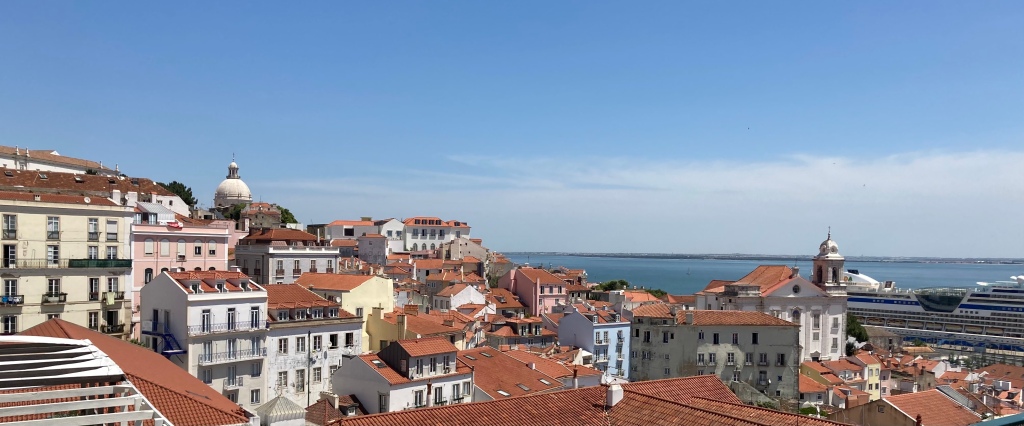
The red tiled roofs of Lisbon’s Alfama district look out over the Tejo river.

Being able to speak Portuguese, even a few words, is a huge advantage for anyone planning to move to this lovely country. Yes, many Portuguese people, especially those under 40, speak very good English. They are ready to help you even if you start off speaking to them in their own language. But they are usually delighted when you show that you’ve made the effort to learn and they will often compliment you on your halting sentences.

Portugal is becoming a popular potential retirement destination for an increasing number of people from the US. If you are one of those considering a move, it is worth making a scouting trip to explore different parts of the country and get a feel for life here. It is also very valuable to familiarize yourself with the language before you come.

That said, if your pronunciation is off you may get blank stares even though you think you have said the word correctly. It’s worth mentioning that there is a big distinction between the Portuguese spoken in Portugal and that spoken in Brazil. Think about the variations between the English spoken in the UK, the United States and Australia. Or the Spanish spoken in Spain versus that used in Cuba, Mexico or Argentina. 

Online language learning options

There are several online options to learn Portuguese. I followed an online course offered by Babbel.com. It was simple, practical and fun. The monthly subscription is currently $11.15 if you sign up for six months, less for longer subscriptions. Duolingo as an app you can use on your mobile phone with a free option. It gradually builds your vocabulary and grammatical skills. It also nags you daily to keep going. Babbel and Duolingo only offer the Brazilian version, but I still found them useful. After all, Portugal still has close ties with its former colony Brazil. There are hundreds of thousands of Brazilians now living in Portugal.

There are options for learning European Portuguese too. You can try the app Memrise, which does have a limited free version. There is also PracticePortuguese where you can listen to short conversations. If you subscribe, you can follow along with the text. The idea was developed by a Portuguese guy and his Canadian partner. It has useful information on the nitty gritty stuff like verbs as well.  PortuguesewithLeo is a fun alternative available on YouTube. If you do move to Portugal, in most towns there are opportunities to take Portuguese classes at a local secondary school (high school) for a very nominal sum, maybe 8 euros (less than $10.) 

Lost in translation?

There are of course a lot of Portuguese people who do not speak English. Some people use Google Translate to help them communicate in those situations. However, it’s not always foolproof. I know one woman who somehow managed to ask a very formal Portuguese man she met at a grand country hotel if he would marry her! Luckily he had a sense of humor. I have found the app Deepl to be very helpful when I need to translate a sentence quickly. 

A couple of words and phrases that will stand you in good stead. “Casa de Banho” pronounced “cah-zah de bahnyo” means bathroom. A conta “ah cawn-tah” means the bill at a restaurant. Cerveja “ser-vay-zhya” means beer. Thank you is “Obrigado” for a man, “Obrigada” for a woman. “Bom dia” is good morning, “boa tarde” is good afternoon. So, good luck, or boa sorte, with learning Portuguese.

Follow my blog to learn about daily life in Portugal and check out my novel “The Power of Rain” on Amazon.

The Dom Luis Bridge over the River Douro in Porto, Portugal’s second-largest city.

A few useful tips about life in Portugal

Cristo Rei statue overlooks city of Lisbon
Rayburn/Lisbon skylie
The red tiled roofs of Lisbon’s Alfama district look out over the Tejo river.

Portugal has become a much sought-after destination for many US retirees. I have to admit that I fell in love with the country when I visited it for the first time in June 2011. I moved here in 2019 and I am still in love!

For anyone considering the move, I always advise making a reconnaissance trip to the country. You can do all the research you like online, but nothing beats an in-person experience. One of the most wonderful things about Portugal is the interactions with individual Portuguese people. You will find so much kindness and charm.

That said, here are some of the things that people ask about when they post questions on the numerous Facebook groups that cater to expat interests.

Cost of Living

Portugal is much less expensive than most other countries in western Europe. For some detailed comparisons about daily living expenses, check out: https://internationalliving.com/countries/portugal/cost-living-portugal/

Climate

It may come as news to some, but Portugal is not a mediterranean country. The western and southern coastlines are on the Atlantic Ocean. The Mediterranean sea ends at the straits of Gibraltar.

Still, Portugal’s climate is mild in winter. In the center and north of Portugal it can rain a lot during the autumn and winter. The weather is warm to hot in summer, the further south you go, the hotter and drier it is. For details, check out: https://www.expatica.com/pt/moving/about/portugal-climate-100067/

Cuisine

Portuguese food tends to be unsophisticated compared to, say French cuisine. But the ingredients are usually fresh and the cooking is honest. They do grilled meats, chicken and fish very well. Sardines and cod fish are hugely popular. The country produces excellent olive oil and lots of good quality inexpensive wine. And Port of course! For details on Portuguese food, check out: https://www.portugal.com/food-drink/10-best-portuguese-foods-and-dishes/

So start researching your journey! Follow my blog to learn more about daily life in Portugal.

An array of snacks laid out before a Christmas Eve dinner in Portugal.

Meet my new book and hear all about it

The cover of my new novel, “The Sunshine Solution” a Digger Doyle mystery

I am very excited to say that my new novel, “The Sunshine Solution” is now available in Kindle format as well as in paperback. It’s the second in my Digger Doyle Mystery series, featuring the feisty young reporter,Elizabeth “Digger” Doyle. My first novel, “The Power of Rain” came out in 2022 and won a National Federation of Press Women award. The books are inspired by my years as a reporter at the Albuquerque Journal.

You can get my books through Amazon or my website, RosalieRayburn.com. Best of all, for my Albuquerque friends, the new book is now available through some local bookstores: Organic Books in Nob Hill, Bookworks on Rio Grande, Treasure House Books & Gifts on the plaza in Old Town Albuquerque. It will also be available soon at Books on the Bosque on the West Side. I love supporting independent bookstores!

Write a review

I’m asking all my readers to please rate it on Amazon or Goodreads and write a brief review so that more people can enjoy it.

Here’s what some readers have said about “The Sunshine Solution”

“Rosalie Rayburn’s “The Sunshine Solution” takes readers on a gripping journey through the intricate world of investigative journalism and political intrigue, presenting a sequel that lives up to the high standards set by its predecessor, “The Power of Rain.” Reviewer Pratibha Malav in Goodreads.

Or this from Sarah Jane Herbener of Savvy Communication,

“In her fiction debut, 2022’s The Power of Rain, author Rosalie Rayburn introduced a fascinating and multifaceted protagonist in newspaper reporter Elizabeth “Digger” Doyle — and then created a story worthy of her, with insightful characterization, deft plotting, and a sense of place so strong that the reader could practically feel the New Mexico desert breeze and taste the red chile in the posole.

Now, in The Sunshine Solution, we revisit Digger as she navigates newlywed life and an intense political campaign with her beloved Maria; settles into a new career in government, now that her longtime employer, the Las Vistas Courier, has folded; explores the hopes, dreams, and challenges of life in today’s New Mexico; and, of course, helps to solve a brand-new mystery, one that will keep readers guessing, with clever revelations at every turn.

Illuminating, profound, deeply romantic, even comic at times, the Digger Doyle novels truly are a treat, even if you’re not a mystery buff. If you haven’t read The Power of Rain, you’re in for a double treat: start there and then continue with The Sunshine Solution. You’ll love the time you spend in Digger’s world.

Meet the author

I’m also happy to say that I have scheduled two events in February where I will be reading from the new book, talk about writing it, and will have signed copies for sale. The first event will be at 10 a.m. on Sunday, February 17 at the Martha Liebert Public Library in the town of Bernalillo. The second booksigning/reading will be at 1:30 p.m. at Treasure House Books & Gifts on the Plaza in Old Town, Albuquerque.

My new novel “The Sunshine Solution”.
The Digger Doyle mysteries are set in New Mexico.

Portugal rolling in dough at Christmas

A tray of Rabanadas, a Portuguese variation on French toast, is part of the dessert selection at the Christmas Eve meal.

In Portugal, holidays and festivals of any sort always involve food. Christmas has its own repertoire of specialities. Many of those feature dough in the fried form. Think of a half dozen variations on the humble donut and you get the idea.

The traditional favorites have delightful names and some surprising ingredients. There are “rabanadas”, or golden slices,which are a Portuguese take on the popular French toast recipe. They are made from sliced baguette bread soaked in milk, then dipped in beaten egg and coated with cinnamon and sugar.

Azevias are another doughy deep-fried treat often made with a sweet potato, chick pea puree or squash (abobora) filling! Another donut-like sweet served at Christmastime are “filhós”, also called “sonhos” which means “dreams.”

A selection of desserts: Bolo Reinha (left), azevias (top) and rabanadas (below)

Getting away from dough, Bolo Rei is a highly visible treat sold everywhere in Portugal during the Christmas season. It is a round, slightly heavy, cake with a hole in the middle and decorated with colorful pieces of crystallized fruit. A variation on this cake is called Bolo Rainha, or Queen’s cake. It is decorated with nuts and dried fruit but no crystallized fruit.

What no turkey?

I was honored this year to be invited by a Portuguese friend to join his family for their Christmas dinner. In much of Portugal, the most important Christmas meal is a family dinner eaten late on December 24 or Christmas Eve. The main dish is codfish served with boiled potatoes and cabbage. Apparently the tradition of eating fish at Christmastime dates to the Middle Ages when the Catholic church forbade eating meat around big religious holidays.

Pieces of baked codfish (bacalhau), and potatoes and a plate of cabbage are the traditional fare on Christmas Eve in Portugal.

The popularity of dried cod fish in Portugal has its origins in trade with the Vikings. Those ancient Norsemen caught the fish and used salt to preserve it. Salt they bought from Portugal. It made a lot of sense in the centuries before refrigeration. Television ads nowadays still promote “Bacalhau de Norwega” in December.

The fish has to be soaked in water to remove the salt before it can be cooked. But even though it is laborious to prepare, bacalhau, remains one of the most ubiquitous foods in Portugal. There are reputedly hundreds of recipes based on bacalhau. Every supermarket has a display of the huge, triangular shaped dried fish that give off a distinctive odor, that reminds me of a smelly locker room.

Dried salted cod fish (bacalhau) on display at an outdoor market in Portugal.

Now that Christmas, Natal, is past, we look forward to the Passagem do Ano, or New Year’s Eve. Which is an occasion for a lot of fireworks.

New Year’s Eve fireworks display in São Martinho do Porto, Dec. 31, 2022.

Follow my blog to learn about everyday life in Portugal. Or check out my website, RosalieRayburn.com to read all about my novels.

Sun shining on my new book

My new book, The Sunshine Solution: a second Digger Doyle Mystery

My latest New Mexico-based mystery featuring intrepid reporter Elizabeth “Digger” Doyle came out in mid-November. It is a sequel to “The Power of Rain” which came out last year and won a National Federation of Press Women Award.

Digger Doyle earned her nickname by exposing the shady secrets of politicians in the fictional New Mexico city of Las Vistas. In “The Sunshine Solution” Digger has landed her dream job with a government department in Santa Fe. When her new boss asks Digger to spy on a political rival’s announcement for a multimillion-dollar solar energy project, she suspects her boss is hiding something and the project is a cover-up.

Investigating the solar company, Digger and Manny Begay, a former newspaper colleague, follow a team of imposters from the ancient walls of Chaco Canyon to the twisting streets of Santa Fe, to a struggling Native American pueblo community. The pursuit brings Digger into conflict with powerful forces bent on revenge by harming her wife Maria and destroying a man’s political career.

Support local independent bookstores

I believe it is very important to support all kinds of local businesses. Too many wonderful shops have been swallowed up or forced to close because of giant megastores and online shopping. That is why I am delighted to say that my books are available from local bookstores in Albuquerque. Organic Books in Nob Hill, Treasure House Books & Gifts on the Plaza in Old Town, and Bookworks now have copies. Books on the Bosque on Albuquerque’s Westside, has also told me they plan to carry my books.

Of course, both books are also available in paperback and Kindle format from Amazon.

Mark your calendars for these events

I am excited to say that I have also arranged two book signing/reading events. I worked with Library Director Joseph McKenzie to hold a book signing/reading at the Martha Liebert Public Library in Bernalillo on February 17. The second event will be at Treasure House Books & Gifts on February 18. More details will be available closer to the dates, but please mark your calendar. I hope to meet and chat with my New Mexico readers at one or other of the events.

A dog’s tale

In other, totally unrelated news. Readers of this blog may remember the story of Divina, the little dog who adopted me after she was abandoned in my village. I walk Divina every morning at about the same time as the bakery van drives through delivering fresh rolls. The delivery lady, “padeira” in Portuguese, stops at the houses where the occupant has hung a bag on the gate with enough change for the day’s rolls.

One morning a few months ago, Paula the kindly padeira was stopped at a house and Divina rushed up to her, all big brown eyes and wagging tale. Who could resist? Paula gave her a piece of roll.

Fast forward to the present day. Divina and Paula now have an unshakeable friendship founded on bread. Divina even discovered she could jump over my front wall to run after the bakery van. I had to put up new fencing. Ah, the joys of being a dog mom!

Divina

Portugal lively with Christmas spirit

Festive lights and throngs of people reflect the lively Christmas spirit in the Baixa area of Lisbon.

Christmas spirit is everywhere in Portugal in December. Markets in cities and towns sell handmade specialties and decorations. Churches and public places stage nativity scenes called “presépio” in Portuguese, and the streets of my small town of Tomar, ring with Christmas music.

December has begun with the usual wet wether. Rain in Portugal often falls in torrents and many people complain of dampness in their homes. But the Christmas spirit survives. The town of Tomar, near where I live in central Portugal, set up a mini-winter wonderland in the Praça da Republic, its main square. A tiny train chugs around a snowy landscape, and a festive carousel twirls round while several market stalls sell artisanal items, sweets and seasonal drinks.

Of football and families

My Portuguese teacher recently told me Portugal is all about the three “Fs”, which stand for “Football, Fado and Fatima.” The first one needs no explanation to anyone who was alive during the last month when the World Cup dominated the sport world. Football (soccer in the US) is practically a national religion in Portugal. When I watch the evening news on SIC Noticias, there is about five minutes of spot news coverage before it switches to interviews and discussions about leading Portuguese teams such as Benfica. And of course, Cristiano Ronaldo, is pretty much a national hero.

Fado is the traditional Portuguese singing style, which has a slightly mournful sound meant to convey a sense of longing. Fatima is a pilgrimage site in central Portugal where the Virgin Mary is said to have appeared to three shepherd children in 1917.

There should also be a fourth “F” for Family. The family is extremely important to Portuguese people especially at Christmastime. On Christmas Eve, families get together to celebrate with a meal called “consoada”. The tradition is that they abstain from meat, so the main dish is salted cod “bacalhau.”One favorite recipe for the cod is “bacalhau com broa” in which a bread made from corn meal is used along with sliced onions and potatoes. This is often served with boiled potatoes and cabbage. In the north of the country, close to the border with the Spanish province of Galicia, octopus is a traditional dish.

On December 25, Portuguese families in typically resourceful fashion, use the leftovers from the consoada meal to make a dish known as “roupa velha” or “old clothes. I remember a similar sounding dish called “ropa vieja” on the menu in a Cuban restaurant in Miami. When I went to order it, I made a critical mistake, calling it “ropa sucia” which means “dirty clothes. Luckily the waiter understood what I wanted.

Sweets and other traditions

Portugal has wonderful bakeries where you can always find a tempting display of sweet pastries. Stores everywhere at Christmastime sell the traditional “Bolo Rei” (king cake) which is a round, rather heavy, cake decorated with crystallized fruits in red and green.

Streets and marketplaces in towns all over the country are festooned with lights and decorations. Seasonal markets selling artisanal crafts and liqueurs are typical as well. And what would Christmas be without a nativity scene. In Portugal a nativity scene is called a “presépio”. One of the best-known presépio displays is in the town of Penela, central Portugal. Set up around the town’s hilltop castle, it features around 200 animated displays as well as an array of street entertainment and cultural activities.

Merry Christmas and Happy New Year, or as they say in Portugal, Feliz Natal e um prosper Ano Novo.

And of course, don’t forget to follow my blog and get a copy of my new book “The Sunshine Solution”

A giant conical yuletide tree graces the Praça do Comercio in Lisbon at Christmas time.

When Irish Eyes are Smiling: memories of home then and now

A winding country road in County Wexford near my former family home.

I took a break from Portugal last week to go visit my brother in Ireland. He has recently returned to settle there after decades in the US, Asia and France.

Ireland was our adopted home for many years. My father brought us to live in the “Emerald Isle” in the early 1970s. In those days, Ireland was a poor country with a high rate of emigration––young people fled to England or the US seeking jobs and better opportunity. Not so now!

Ireland is bustling with activity; its population growing, cities expanding, an impressive network of new roads and an array of international foods that were unthinkable in the seventies.

Actually, living in the country in Portugal now reminds me a lot of Ireland many years ago. And there are things about Ireland that remind me of Portugal! In Enniscorthy, the town in County Wexford nearest my brother’s, and my late father’s, home, I heard Portuguese spoken in a local Dunne’s Stores supermarket. There is even a Portuguese restaurant in Enniscorthy. How times have changed!

College Days

I flew Ryanair from Lisbon to Dublin. My brother and sister-in-law picked me up from the airport and we headed into the city. I have visited Ireland several times over the last twenty years, but am always amazed at the increase in city traffic. It took us more than an hour from the airport to reach the city center and find a parking hall near St. Stephen’s Green.

We searched for a lunch spot and as luck would have it, we happened upon O’Neill’s. The pub is a stone’s throw from Trinity College my brother and I were both students. O’Neill’s was always the pub we could go after evenings studying in the library and get a half pint before closing time. In those days a half pint of Harp used to cost about 14 pence in those days. Of course my weekly budget was only about £5. (That was long before Euros.)

After lunch we wandered over to the college. It was a gray and drizzly day which reflected the color of the, mostly eighteenth century, buildings in the TCD campus, but it was fun to walk around and reminisce about our four years as students there.

Colorful fields

Ireland is commonly referred to as the “Emerald Isle” for a reason. Ample rain all year long makes for a lot of green fields. But there is a richness of color everywhere. During the summers the crops are a dozen shades of golden. In the autumn there are the browns of newly plowed fields, and the deep greens of hedgerows. It was a joy to see a whole variety of trees in vivid fall colors. Where I live in Portugal I am surrounded by evergreen oaks and olive trees which remain unchanged year round.

A corn field in County Wexford after the harvest.

Favorite Foods

I mentioned the astonishing array of international foods now available. The local Dunne’s Stores supermarket had a whole aisle full of Indian, Thai, Italian and other specialties. I saw several Indian restaurants in the small country towns as well. But the old favorites are still there. Irish soda bread! The delicious loaves made with a mix of brown and wholemeal flower, sour milk and bicarbonate of soda as a rising agent. Nothing like it for breakfast or at any time of day. With Irish butter of course!

A pile of Irish soda bread loaves. The cross cut on the top is to prevent the loaf from cracking and splitting.

Follow my blog to learn about daily life in Portugal. Check out my website https://www.rosalierayburn.com/to read about my novels.

Grateful for Portuguese healthcare, there for you when you most need it

The Cristo Rei statue appears through the mist above the Tejo river near Lisbon. It was a reassuring sign when I suffered a minor accident.

A recent trip to Lisbon to visit a friend gave me an unfortunate opportunity to experience the Portuguese healthcare system. I ended up taking an unexpected trip by ambulance to a local hospital where I received a CT scan, X-rays and saw an orthopedic doctor. At the end of the day, they cleared me to leave, with no concussion, no broken bones, and no bill! They called me a taxi and that was that.

In the USA I would probably be facing bills totaling hundreds, if not thousands of dollars. Here, no bill. I am enrolled in the Portuguese healthcare system, thank goodness!

One missed step causes crashing fall

I had enjoyed a lovely breakfast of coffee and a chocolate croissant with my host at a local cafe, packed my things and said my farewells. I was planning to take the train from Lisbon back to my home in central Portugal.

My friend’s apartment is on the first floor (second floor American style). A steep flight of narrow wooden stairs leads to the ground floor. Halfway down, I missed a step and plummeted headfirst downward, hitting a wall with my head and left shoulder. I lost consciousness briefly, was shaky and in great pain.

My friend called the 112 emergency number and minutes later an ambulance arrived. The young “bombeiros” crew, who are trained as firefighters and EMTs, took me to a local hospital. I arrived at the Garcia de Orta facility around 10:30 in the morning.

The waiting area was full of people in all states of pain. People on gurneys, in wheelchairs, hooked up to oxygen supplies and medication drips. Hospital staff rushed back and forth constantly.

This was a normal hospital on a normal day, but the frenetic atmosphere made me think of news reports on how very terrible the situation must be at hospitals in Gaza which are currently under bombardment and have no power, water or medication.

I feel fortunate for the help I received

Within about half an hour, I was triaged. I had to show my “Numero de Utente” to prove I am enrolled the Serviço Nacional de Saude, the Portuguese healthcare system. Then my superficial cuts on my knees were bandaged. A short time later I was prepared for pain medication which was given via a drip. I was told I would have a scan to check for concussion and would then see an orthopedic doctor.

About 90 minutes later I had the CT scan, then the shoulder X-ray. Another 90 minutes of waiting and I received the all clear results about the CT scan. No concussion. I was told I would see an orthopedic doctor next.

The afternoon dragged on while I waited to see the ortho doc. But around 4:30 p.m. someone came around offering me a small sandwich and a bottle of water. Half an hour later I was called in to see the orthopedic doc. He tested my left arm and shoulder and declared it was not broken and the tendons were ok. Just get checked again in a week, take ibruprofen for the pain and ice it, he said.

Then I was cleared to go. They even called a taxi for me to get back to my friend’s apartment.

I was so relieved by this experience. But this is not to say that all is perfect here in Portugal. On the news the next morning there were extensive reports of strikes by doctors, nurses and other hospital staff, protesting and low pay and long working hours. I would definitely support their cause!

The hospital in Tomar, central Portugal. This is the first port of call for patients in my area. If your case is more serious, you will be transported to a larger hospital in Abrantes. Each region has its different levels of hospitals. There is also a parallel system of private hospitals for those with private health insurance, but these are the regular Portuguese health system facilities.

Follow my blog to read more about daily life in Portugal. And check out my website RosalieRayburn.com. I have a new book out. It is a mystery called “The Sunshine Solution”.

My new mystery novel about to launch!

The cover of my new book, “The Sunshine Solution” coming out in November.

I feel as excited and apprehensive as a mother about to give birth! My new book, “The Sunshine Solution”, will be coming out in just a few days. It is a sequel to my first novel, “The Power of Rain” which won a National Federation of Press Women Award.

The Power of Rain introduced readers to investigative journalist, Elizabeth “Digger” Doyle, a plucky young reporter who earned her nickname by exposing the shady secrets of corrupt politicians in the fictional New Mexico city of Las Vistas.

The Sunshine Solution continues the exploits of Digger and Maria Ortiz, the artist activist whom Digger helped to save a historic Spanish chapel from a rapacious development scheme.

The new story opens with Digger settling into a job at the Cultural Affairs Department while Maria is running for election in the state legislature. All seems calm.

But when Digger’s new boss asks her to spy on a political rival’s plan for a solar energy project, her reporter’s instincts tell her something is amiss, and trouble ensues!

What advance readers are saying

Illuminating, profound, deeply romantic, even comic at times, the Digger Doyle novels truly are a treat, even if you’re not a mystery buff. If you haven’t read The Power of Rain, you’re in for a double treat: start there and then continue with The Sunshine Solution. You’ll love the time you spend in Digger’s world. – Sarah Jane Herbener, Savvy Communication.

And this:

Digger investigates a scheme to establish a solar panel array at a site that encroaches on pueblo land and features developers with conflicting motives – altruistic for the candidate for Governor, Chris Lovington, and devious on the part of Digger’s boss, the Secretary for Cultural Affairs.

At the same time, an election is imminent and Digger’s wife Maria is a candidate for the State Legislature, with all the tensions and drama of a political campaign. Maria contends with a vindictive ex-girlfriend and a corrupt opponent and Digger uses her journalistic skills to uncover and reveal the unsavory truths about the complex election issues.

In the background is the state of New Mexico itself, its scenic beauty which the author describes with great effect, and the cultural and historical background of iconic places such as Chaco Canyon and the city of Santa Fe. – Sue Broidy, author of “An Unexamined Life

The Power of Rain won a National Federation of Press Women Award.

Background to the stories

I spent 18 years as a reporter in New Mexico and I always thought there were great stories in the political theatrics I witnessed. I also wanted to honor New Mexico, a state I love for its rich blend of cultures. There are the many Native American pueblo communities, the areas that belong to the Navajo Nation, the extensive history of Spanish settlers from the early 1600s, and of course a lot of cowboy culture. It is an arid state, but the high desert and the mountains have such a magical beauty of their own.

So I hope you can enjoy my new novel, and read the first one if you haven’t already met Digger.

Early morning in Albuquerque looking at the Sandia Mountains.